

Shiny object syndrome is killing your financial autonomy.
Almost everyone has experienced shiny object syndrome at some point, especially in the beginning stages of pursuing a new goal like creating an independent source of income online. Maybe you tried dropshipping, or affiliate marketing, or freelancing, or creating content on social media. But after a few months of an online course and your own trial and error, you have little to show for your efforts, another shiny object catches your eye, and the cycle repeats.
We’re going to stop that cycle today and give you the clarity you need to create the right path for you to maximize your income without burning out.
Last week’s newsletter was all about financial autonomy (having the financial means to do the things you want to do without being tied to the things you don’t want to do) and why it’s in our best interest, individually and collectively, to maximize this autonomy.
Today we’re doing a deep dive on three high-leverage mechanisms you can implement to increase your financial autonomy. Each of these components increases earning potential and decreases cost and friction in their own way. You don’t necessarily need all three, but stacked together they become greater than the sum of their parts.
But before we can get into these mechanisms, we have to touch on the one skill that lays the foundation for everything.
The Truth About Making Money
Nobody likes to be sold to. No one likes telemarketing calls, no one likes ads, no one likes being stopped in the street to be pitched.
There’s a reason for that.
Most of us have had some negative sales experience of some kind that leaves a bad taste in your mouth. This taints your perception of sales and salespeople, seeding a bias against being sold to.
These bad experiences come from the bad actors in the sales space, and unfortunately they discourage people from going into sales because they give it a bad name.
Unfortunately, selling is unavoidable. There is actually no way to make money that does not involve a sales transaction of some kind. Money is just a certificate of appreciation given in exchange for something of value. This is important to understand because a lot of people have an aversion to selling. They may try to avoid it for fear of discomfort or acting unethically, but the reality is that if you’re making money in any way, you are engaging in a sales transaction.
Even a regular day job is a sales transaction. First you have to sell yourself in the interviews to get the position. And every day you clock in, you’re selling your time to your employer at a fixed rate.
The point is you have to be somewhat comfortable with sales if you want to make money because everything is sales. The good news is that it doesn’t have to be unethical. This is a common misconception, again usually seeded by negative past experiences. Often it manifests as “Rich people only get rich by screwing over the rest of us, and if I want to get rich I have to do the screwing over.” But it doesn’t have to be this way.
When it’s done right, selling is serving. Both parties are better off after the transaction than before. Serving comes down to education, problem solving, and value delivery. Educating is important (and often overlooked) because a lot of the time potential customers aren’t even aware that they’re dealing with a problem. And if they are, they may not be aware that a solution exists.
The main purpose of a business is to solve a specific problem. The mechanism is the value delivery. The business could solve the problem for the customer and the value delivery would take the form of a service. Or they could sell a product, which enables the customer to solve the problem themself, still using the business’s solution. Or they could sell the information the customer needs to create the solution independently, the mechanism being education.
It all boils down to this: making money is selling, and selling is serving. Learn to serve well and making money will be much easier.
Maximize Profit, Minimize Cost
One of the best ways to start practicing selling and serving is with digital products. Not only do they make a good entry point, but also go a long way in reducing investment costs and increasing earning potential.
A digital product is a product that’s delivered virtually (i.e. not a physical product) like eBooks, online courses, tools, templates, live events, digital subscriptions, PDF guides, etc. Digital products typically have a much lower barrier to entry because there are no raw materials costs, no manufacturing costs, no inventory cost, no shipping cost, etc. Because the product only ever exists in the digital space, it eliminates a whole host of hurdles businesses have to deal with when selling physical products.
Beyond the cost savings, digital products dramatically reduce operational friction. There are no suppliers to manage, no manufacturing delays, and no shipping logistics for you or your customers.
But there’s an even bigger benefit to digital products that has the power to increase earning potential exponentially, and that’s scalability. Because the product is created digitally, this gives you the ability to create once and sell infinitely.
I’ll say that again: Create once, sell infinitely.
Profit margins on physical products are limited by how much the materials and labor cost to make the product, because every unit needs to be created from scratch. With digital products, you only need to make it once. This means the more units you sell, the closer your profit margins approach 100% which is pretty much impossible with physical products.
The low cost, low friction, and scalable nature of digital products make them one of the fastest ways to start gaining experience selling and serving. Unless you’re already committed to a specific physical product, start with a digital one. You’ll get valuable sales experience much faster because you can begin serving customers immediately instead of spending months or years developing inventory and supply chains.
Remember, use it as an opportunity to serve. People who buy your product should feel like they got something out of it. They should feel like it helped them move from the problem closer to the solution. Spend a weekend making a PDF guide on a topic you’re relatively knowledgeable about and you have an asset you can keep selling forever.
Minimize Effort, Multiply Income
But what if you’re not an expert at anything? What if you don’t have a solution to a problem or enough knowledge in a certain area to create and sell a digital product?
Well you don’t have to be an expert to create a digital product or even to sell it. You just have to be more knowledgeable than a beginner. If you can help a beginner, there’s nothing stopping you from selling a basic info product except for yourself.
But if you aren’t confident enough to create your own product just yet, don’t worry. You can still practice selling and serving by promoting products that have already been created and are already solving the problem for customers.
This concept is called affiliate marketing and it allows you to partner with brands and companies that are already selling successful products. As an affiliate, you recommend the product to new customers, and when someone purchases, you get a cut of the sale.
This creates a win-win-win scenario. First, the customer wins because now they have a solution to a problem they were not previously aware of. The business wins because they made a free sale, thanks to you. This was a sale they would not have otherwise made, so they’re happy to share the profits with you by paying you a commission. And you win because you get paid for helping someone solve a problem.
Affiliate marketing is another good place to start because it eliminates even more responsibilities than digital products. As an affiliate, your sole responsibility is promotion. No need to worry about inventory, fulfillment, or customer service or even developing the product in the first place. The company takes care of all that, which means you can come in and start selling from day one. This is a great way to start getting the reps in.
There’s another more subtle benefit that comes from this. Yes, the company has already developed the product which eliminates one of the most challenging aspects of business. But they’ve also validated the product, which means they’ve done enough trial and error to know that the product they’re selling does 2 things. First, it actually solves a problem that people have; and second, people are actually buying the product.
It doesn’t matter how good an idea is, there has to be demand for the product, and market validation is one of the most painful processes of business. If you’ve spent a lot of time and money on developing a prototype, you can get attached to it. And if the market wants something different, you essentially have to part with your baby. Affiliate marketing eliminates this entirely.
This brings us to the ultimate benefit of affiliate marketing: multiple income streams.
Because you’re only focused on marketing (not research, development, procurement, manufacturing, distribution, fulfillment or customer service) you have more bandwidth and you’re able to promote multiple products. This gives you multiple sources of income which creates some redundancy. If something happens with one product (it’s discontinued, becomes controversial, etc.) you don’t lose all your income because you’re simultaneously selling other products.
And you can take this a step further by promoting a handful of offers in the same niche or topic. That way, you can promote multiple products to the same audience, essentially multiplying your commissions with very little additional effort.
You can affiliate with all kinds of businesses and products, including physical products. If the problem you’re focused on solving requires a physical product, I recommend affiliating with an existing solution if possible before trying to create your own prototype. This bypasses all the serious logistical friction and operation costs mentioned in the last section, and reduces threat of competition.
But ideally, I recommend affiliating with digital products. Why? It’s a matter of margins.
If a company only makes 20-40% profit on the sale of a physical product, they have to pay a commission smaller than that, otherwise they lose money on you as an affiliate. Meanwhile, with 80-90% margins on digital products, they’re much more likely to pay a higher commission because there is still plenty of profit left over. Many companies pay 50-75% commissions on digital products and I’ve even seen some offer 90% or even 100% commissions. Compared to the 5-20% that’s standard for physical products, you can easily see a 3-4x improvement.
No matter what you end up promoting as an affiliate, make sure it’s a genuine recommendation. Don’t promote a product just because it has a high commission. Promote products that you actually use. A good test is to ask yourself “would I promote this even if I didn’t get paid?” if the answer is a definitive no, promote something else.
You may even want to start out recommending products that you aren’t affiliated with. You won’t earn any direct commissions, but you’ll be building trust with your audience and it’s possible that brand deals or affiliations could come from quality reviews/recommendations in the future.
Perpetual Revenue Engine
Digital products increase margins. Affiliate marketing reduces workload.
Community amplifies both by cultivating your best customers.
An online community gives your true fans a place to gather and contribute to your business. This comes in the way of making purchases directly from the community, posting content that helps other members (so you don’t have to), or bringing new members into the community. And they’re happy to do it because you were the one to help them solve whatever problem you specialize in solving. Plus it gives you a number of ways to monetize, depending on the platform you build on.
The importance of community was popularized by WIRED editor Kevin Kelly in his 2008 essay 1000 True Fans. His argument was simple: creators don’t need millions of followers. They need a relatively small group of highly engaged supporters willing to buy their products, attend their events, and share their work. Kelly showed that 1,000 true fans spending on average $100 per year could create a six-figure business. Today, with digital products, memberships, and online communities, it’s often possible to reach that level with even fewer people.
The latest technology available gives you a ton of ways to monetize your fanbase. For instance, you could offer digital products for sale right in the community, or promote affiliate offers, or both. You could also create a paid newsletter subscription or a paid membership for an exclusive group within your community. Or you could host live events, contests, or giveaways, charging a small fee for registration. And of course you can combine multiple strategies to increase engagement and efficiency.
This is the endgame for most avenues of digital business. Every successful business has a mission, usually related to solving the focus problem, and they need revenue (the lifeblood of a business) in order to drive forward in that direction.
Online community is the pinnacle solution for both. It helps with problem education and solution integration while simultaneously relieving a portion of that burden from you. And it cultivates the cream of the crop customers who not only purchase your products/services but bring more customers to your community and your business. These are your repeat buyers, raving reviewers, and serial referrers.
The fact that a thriving community is a common end goal and has a low barrier to entry makes it a great place to start. You don’t need a product to build a community. You don’t need sponsors or partnerships. You don’t need millions of followers or book deals or well known podcast guests. You just need to pick a problem and dedicate your efforts to solving that problem for yourself and your members.
If you know what problem you want to focus on and you have a solution, you can use the community as a mechanism to help with implementation. Position it as a way for members to get more direct guidance from you on exactly how to solve the problem step by step, ask questions pertaining to their specific scenario, etc. Then you can sell your own digital products or affiliate offers right from the community as natural solutions without selling or pitching.
If you don’t have the solution to the problem yet, this is still a good place to start. Learn in public. Share the insights and lessons from your attempts and mistakes. When you arrive at the solution you will have documented the whole process, have experience to back up your authority, and built trust with people that understand you actually care about solving the problem, not just making a quick buck.
Again, the followers and members you gain in the beginning will end up being your most loyal customers, reviewers and referrers. They basically become your marketing engine and alleviate some of the marketing burden on you. Hopefully by now it’s clear that this is one of the most powerful mechanisms you can leverage to increase earning potential and decrease cost, effort, and friction.
Putting It All Together
So now you’re probably wondering “What the heck? I thought we were going to break the shiny-object-syndrome-cycle, but now I have 3 new shiny objects to consider. This doesn’t make my life any easier.”
That’s fair.
The goal isn’t to learn all three mechanisms at once. It’s to identify which one makes the most sense for your current situation and focus on it long enough to see results. Use the framework below to determine where to start.
Is there an obvious problem or an area of interest you want to focus on?
If YES: Have you already solved that problem for yourself or someone else?
If YES: Did you devise the solution or did you find someone else who had the solution?
If YES: Productize your solution in a way that makes sense in the context of your problem space. (Digital Products, Community)
If NO: Recommend the solution that worked for you to others with the same problem. Affiliate with that product if possible. (Affiliate Marketing, Community)
If NO: Start learning in public. Build a community around your journey toward solving the problem. Share what you’re learning, what’s working, what’s not, and the lessons from your mistakes. This builds trust, attracts like-minded people, and gives you a place to test ideas while developing your eventual solution. (Community)
If NO: Practice conscious consumption. That means paying attention to what kind of content captures your attention, why it’s interesting to you, what additional questions arise after having consumed that piece of content, whether you agree or disagree, and how that information impacts your life. Spend some time identifying real interests. Then join a community focused on topics that genuinely interest you. Pay attention to recurring problems, questions, and ideas that capture your attention. Once you notice a pattern, come back to this process.
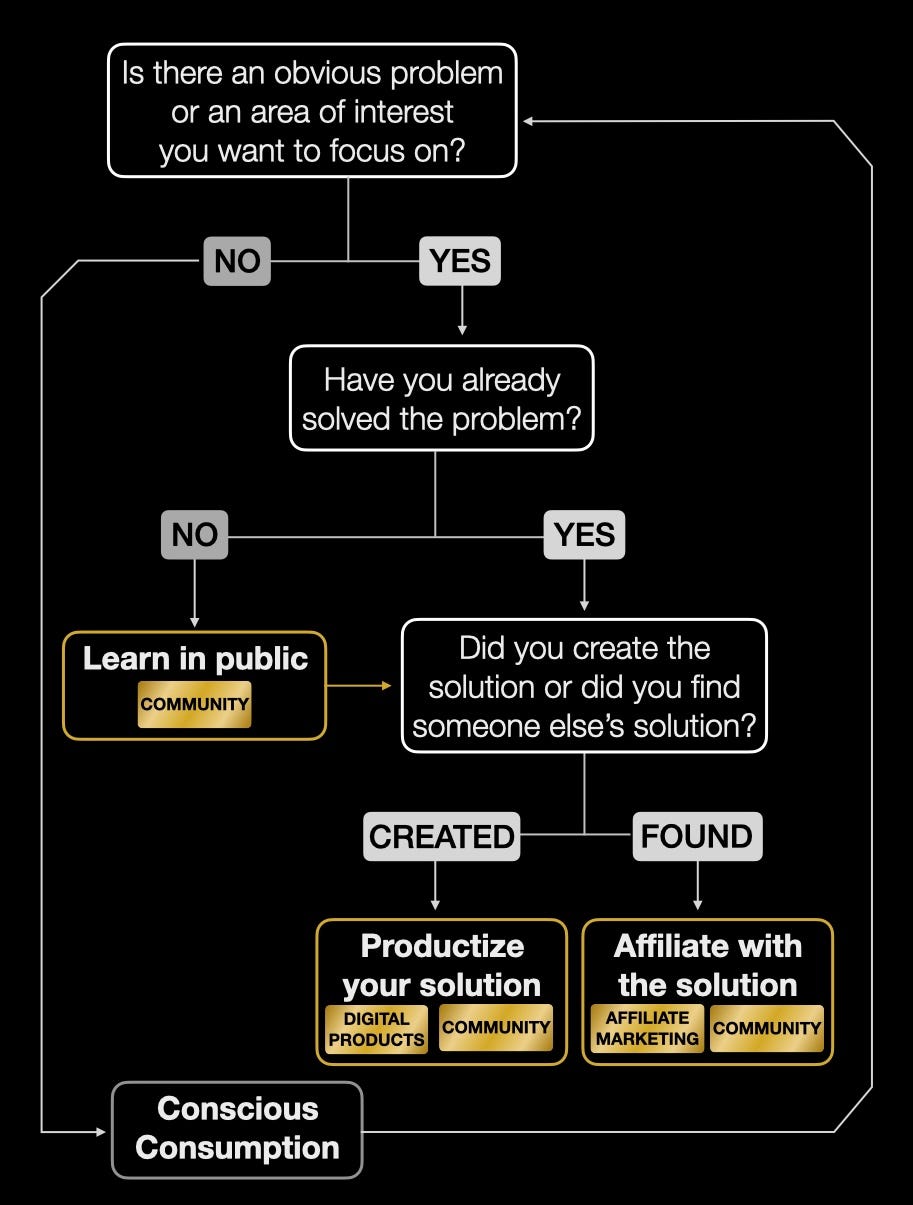
Remember, none of these mechanisms work just because they’re trendy. They work because they increase earning potential while reducing cost, effort, or friction. Follow the flow chart and choose one of the mechanisms listed under where you end up. Don’t think too hard about this, just ask yourself which makes more sense for your situation.
If you already know how your solution would best be delivered, start with a digital product. If you’ve already found an existing product that solves the problem, see if you can affiliate. Even if you can’t, practice recommending the solution to people with that problem (community is great for that). If you know where your expertise lies but not quite sure how to productize, start with community. Pay attention to the questions people ask and build (or affiliate with) products that reduce or eliminate those issues.
If you still don’t know which one to start with, start with community. You’ll notice it’s listed under each possible outcome because remember, community is the ultimate end goal of most digital businesses. And the barrier to entry is relatively low which means it’s also a good place to start, especially because you will probably want to go down the community path eventually anyway.
If you want to learn more about building and growing an online community from zero to 1000 members, come join us for the Mission 1000 live event, designed specifically to show you the most efficient way to create an independent source of online income. The workshop is completely free to join so there is nothing to lose and everything to gain. Register for your seat here.
So now you understand three of the most efficient mechanisms you can leverage to increase your financial autonomy (Check out last week’s newsletter for a deep dive on financial autonomy). The ultimate goal is to create maximum earning potential with the minimum amount of cost and friction to create a sustainable independent income system.
You also now have a framework to determine which of these three mechanisms are worth your time, which one to start with, and where to go from there. Keep this plan top of mind, focus on it, and tune out the distractions. Only take on a side-quest when it supports your ultimate goal. This will go a long way in breaking both the shiny-object-syndrome cycle and analysis paralysis.
Thanks for reading. Subscribe for more.
Talk soon,
Tim