

Your brand identity is not a decision you make in the beginning.
It’s a direction that is cyclically refined over time, until it’s undeniable.
It starts out blurry, and with every cycle becomes clearer.
This is the foundation of your eventual brand legacy.
If you struggle to make decisions in your business or your personal life, this is what you’re missing.
Most people wait until they have absolute clarity before they take the first step.
Which is exactly why so few do it.
The clarity comes from every repetition of the cycle, and you need to take the first step to start it.
I’ll be upfront. This is not a brand worksheet.
The questions in this article aren’t meant to be answered rapid-fire.
If you’re looking for another “what’s your niche?” exercise, this isn’t it.
It’s the mechanism behind your uncertainty, and the 2-part cycle that refines it.
Simply being aware of the cycle puts you ahead of most entrepreneurs.
By the end of this article, you’ll not only understand how it works, but also how to take that first step to kickstart the cycle.
Done properly, this can turn your ideas and beliefs into a legacy that will stick around long after you’re gone.
You’ll want to sit with this a bit.
Brand Direction Is Not Static
The cycle has 5 main components, and you’re probably already familiar with them.
What most people are missing is how they coevolve and fine tune the brand direction together.
Most people don’t understand this until it’s laid out in front of them. But once you see it, it starts to take effect almost immediately.
Even if you’re not running a business, this framework is just as valuable (if not more) when applied in personal life.
Your Vision is the “what.”
What are you hoping to accomplish with this business? This is purely directional. It’s not tied to metrics or deadlines. It’s the world you want your contributions to help create long-term.
What do you do for the business? What does the business do for you? What have you helped your customers accomplish? How have their lives changed as a result?
Be willing to adapt your vision. A good vision is always evolving with the landscape, like a river that gradually changes its path over time.
The Mission is the “how.”
How are you going to make that vision a reality? How do you bring your audience from where they are now to where they want to be?
Just like your vision, this strategy will constantly evolve over time.
New obstacles will emerge, new tools will arise, and the landscape develops on its own. You adapt to those developments, unlock new knowledge, and formulate new strategies on HOW to bring the vision to fruition.
And even though it’s evolving, it will provide a clear sense of direction on how to create that reality.
Don’t change like the weather, evolve like a stream.
And before you know it, your stream becomes a river, your river begins to carve a canyon, and your canyon is your legacy.
It’s what you will leave behind. Long after the river has dried up, the canyon remains.
Your Values and vision are related by your what and why.
Vision is the overarching, tangible what/why - i.e. “What am I doing this for?”
Values are a more specific underlying what/why - i.e. “What do I believe?” “Why is it important to bring the vision into reality?”
Your values are your operating principles.
These beliefs guide your content, offers, advertising, support, and partnerships. You can think of values as the explanations you can give people when they ask why you’re obsessing over this.
You should be able to reduce your values to one word or phrase, and explain the basis of each value in one sentence.
You should also be able to get up on your soapbox and spew about each one for an hour with pure raw passion.
Your Goals are the major milestones you’re working toward.
Just like the vision and values, mission and goals are related as the “how.”
The mission is the broad, overarching “how.” Your goals are the more specific “how.” How will you go about “completing” this mission?
Goals are good for any timeframe over 6 months. And they shouldn’t be SMART.
They should be general, they’re there for you to get a little more clear in the mid-term time frame.
Goals are milestones and Objectives are stepping stones toward those goals.
They’re short-term, specific, and measurable. Objectives are what you can act on now, and provide direction and motivation.
Unlike goals, objectives should be SMART: Specific, Measurable, Achievable, Related, and Time-bound.
Think about it in terms of resolution.
Vision is like 480p on a projector.
Mission is like 720p on a TV.
Goals are like 1080p on a laptop.
Objectives are like 4k on a smartphone.
Each time you’re looking at a smaller part of the picture, but you are seeing with higher resolution.
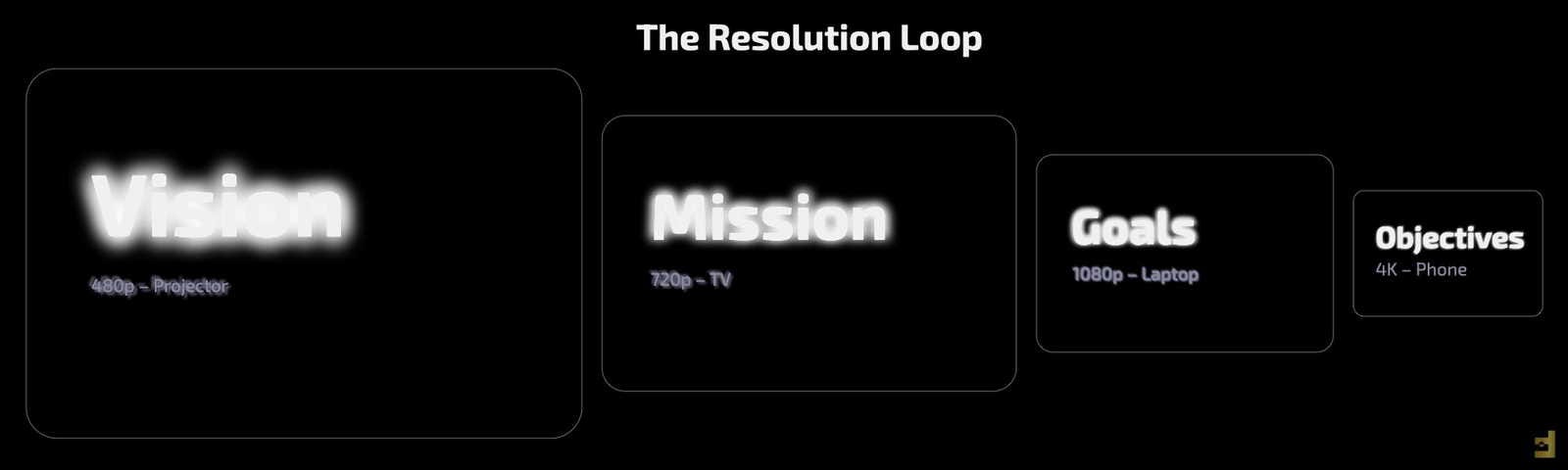
Don’t worry so much about trying to see the vision in 4k. Don’t worry about the objectives for the next goal until you’ve accomplished the current goal.
If there are 100 steps to success, you only need to know steps 1 and 100. Once you take the first step, step 2 will reveal itself to you.
Step 2 may not make any sense until you’ve taken step one.
The 2-part Brand Direction Cycle
These 5 components of the brand direction are constantly evolving.
And each development in one influences the development of the others. They are linked in a 2-part feedback loop as depicted below.
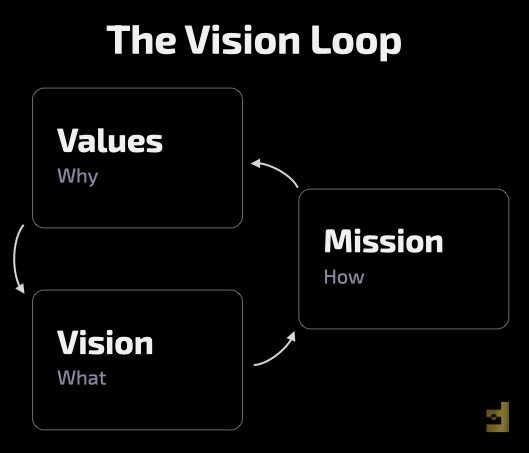
Part 1 is the Vision Loop:
Vision (WHAT) helps you determine your mission.
Your values (WHY) help you determine if that mission is aligned with your beliefs.
And your mission (HOW) reshapes your vision and refines your values.
Part 2 is the Resolution Loop:
Your mission helps you develop your goals.
And your goals help you determine your objectives.
Then the feedback begins.
Passing or failing those objectives helps you reshape your goals, and achieving or failing to achieve goals helps you reshape your mission.
This is the key point. If you don’t make it here, nothing before it matters. You must actually execute for the cycle to continue.
Without executing on objectives, there is no opportunity for feedback and nothing to improve upon, so nothing changes and nothing evolves.
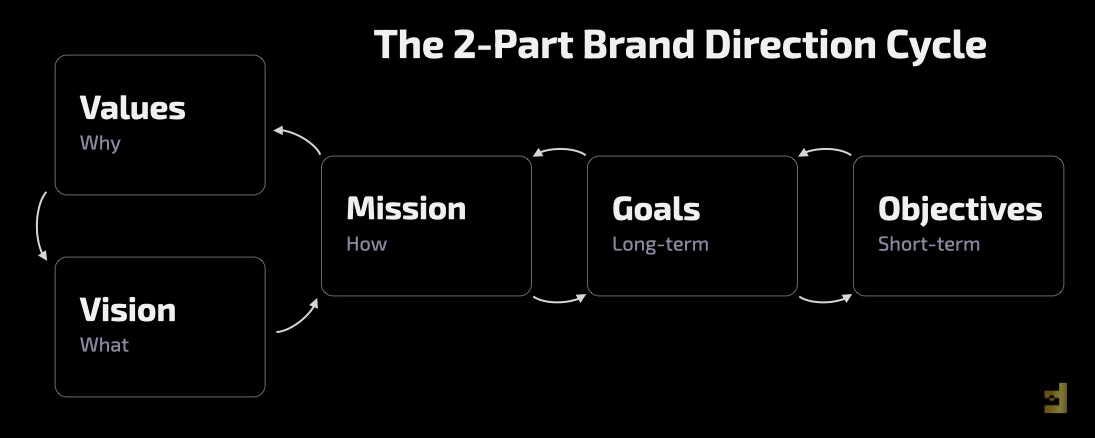
And the cycle continues indefinitely, with both parts constantly running in the background. The more the cycle repeats, the more clarity you’ll have.
You’re not aimless, you’re just in the early stages
This is why the beginning can be so frustrating.
You have all these drastic changes to your vision, mission and values that it seems like your goals and objectives are pointless.
This is when everyone tells you to
“Just do the thing”
“Just be consistent”
“Just pursue your passion”
Which can be good advice in the right context. But stripped of everything else, “just work harder” is a direct path to burnout.
If you don’t have a clear direction, that hard work is just you spinning your tires in the mud and going nowhere.
The actions you take today must support the future you want to build.
If you don’t know what that is, how do you know what to do today?
That’s why that advice usually falls flat. It’s missing half the equation. Of course you’re going to churn and burn if you only have one piece.
Honestly, that’s part of the entrepreneurial process, the learning process, and the growing process.
That being said, you do need both pieces. Direction and persistence.
Like a young stream, in the beginning it’s constantly changing course. But it keeps flowing, and over time, the changes become less drastic. Banks are built up, channels are formed as your stream grows into a river.
And as those changes become more of a fine tuning than a directional shift, your river begins to carve its canyon.
This takes patience. Remember this when you think about quitting.
It’s much easier for a stream to dry up than for a raging river.
A Brand Without Direction Is Just A Logo
A business without a brand is directionless. A brand without direction is a logo.
To define that direction, you have to start by being brutally honest with yourself.
Sit down in a quiet place and give yourself some time to think about this.
What do you believe? What are you adamant other people should believe? What’s the belief that makes you clench your jaw when someone else disagrees? How do you defend your position?
What arguments do you find yourself getting into over and over again? The ones you’ve had 20 times but still can’t shut up about. What topics get you up on your soapbox? What could you spew about for hours on end?
What are people doing wrong that you physically cannot let go? The mistakes that are excruciating to watch someone make. The ones that make you think: If I could just stop them and show them.
What is the ideal world these beliefs support? What world are we avoiding by creating this ideal world instead? Where is the world now and what needs to change to bring about the ideal world?
Do your best to think about this world without the limitations we are so familiar with. When you encounter a limitation in the ideal world, ask yourself if it really needs to exist. If not, why? And what needs to happen for the ideal world to exist without it?
Really marinate on this. You’re not meant to bang out these answers in 5 minutes over a cup of coffee. Take it with you. This is meant to be a continual, conscious practice.
After sufficient marination, ask WHY?
Why is any of this important?
Why is the outcome for you important?
Why is the outcome for your audience important?
What does life look like if nothing changes in five years?
Keep asking why. This is the path to clarity.
Carving Your Canyon
As you sit with this, your vision and values will emerge.
You’ll start to notice recurring patterns, connect dots you thought were unrelated, and formulate strategies to accomplish your vision.
Be sure to write it all out or document it somehow.
Writing it down concretizes the ideas and identifies gaps and contradictions when they arise. And keeping version history helps you keep track of how your brand evolves.
If you’re looking for a more interactive way to go about this, I highly recommend the Personal Brand Strategist custom AI on Eden. It will interview you and probe for the core beliefs and values that make up the foundation of your brand. And it will help you get clear on the vision those beliefs support.
For me personally, one afternoon of conversation put an end to years of brand blurriness. You can try it out free here.
Marinate on the questions above, then start by writing out your values.
Reduce them to one word or phrase and then expand them each into a full sentence.
Pause a moment and have a hypothetical argument with a fictitious dissenter to back up your belief. (It’s worth doing the same from the other side of the belief as well)
Once you’ve begun defining your values, begin to fill in the rest of the components.
Ask yourself what future these values support. How can you make that future a reality within the bounds of your values? What are the major milestones that are necessary to complete the mission? What are the stepping stones you can target in the next 30, 60, 90 days to get closer to those milestones?
Now execute relentlessly.
Without execution, all of this is worthless. It doesn’t matter how pretty your brand document is or how aesthetically pleasing your vision board is.
What matters is executing on the objectives, and continuing the Resolution Feedback Loop.
The more objectives you complete (successes and failures), the more feedback you get and the more you refine your brand’s direction.
Remember, don’t change like the weather, evolve like a stream.
Your stream becomes a river
Your river carves a canyon
Your canyon is your legacy
Long after the river has dried up, the canyon remains.
Talk soon,
Tim
Thanks for reading. Subscribe for more.