

You’re wasting effort on the wrong customers.
If you want to make it easy for your business to generate revenue and grow your customer base, you have to stop spending time catering to your worst fans and customers.
It’s unfortunately a common misconception that the only way to earn more revenue is to get more customers. And that is one way to scale, but it’s a very linear scaling function. And the more customers you have, the more the fulfillment and customer service burdens weigh on you.
But there are more efficient ways to scale your customer base and income than just finding new people to buy your offer.
Certain types of fans and customers are more valuable than others, and if you’re trying to streamline your business to make it as profitable as possible, there are only three that are really worth your time and attention.
These people simultaneously contribute to audience growth and revenue growth. By focusing your efforts on cultivating these three customers, you are extending the longevity, sustainability, and compounding growth of the business.
I call these The 3 R’s of Community, because community is by far the number one capture mechanism that allows these three to contribute to their full potential.
In this article, I’ll break down why each of the three is important and how to build your community properly to cultivate these members naturally, with minimal effort.
First, let’s start with the customers that have the most direct impact on your bottom line.
And, I should say that there are other ways to increase your revenue, such as making larger offers available and/or more of them. This article is focused specifically on the types of customers that contribute to business growth and longevity.
Part 1 - The 3 R’s of Community
“Your fans don’t treat you equally, and you shouldn’t treat them equally either”
The First R
Likely the most obvious of the three are the Repeat Customers. If the desired outcome is to generate more revenue, these customers are generally the number one contributor.
These people bought a product or service from you and decided it was so effective at solving the problem, they either bought it again, or trusted you enough to purchase another solution to a different problem from you.
This is good because the more of your offers these customers have purchased, the more likely they are to purchase the next one, which is not only great from a revenue perspective, but also from a product validation standpoint. These customers let you know your product is effective, and there is demand for it.
Most of the value of repeat buyers comes from recurring revenue, and this can be simplified with a subscription model. The caveat here is that you have to use it ethically.
If you’re selling a digital product like a PDF guide, don’t charge a monthly fee for the customer to maintain access to the guide, just make it a one-time purchase. If there’s anything people hate, it’s a recurring fee for a one time product.
Generally, subscription models work best for things like premium memberships, ongoing coaching, software products that require continual or recurring usage, and any other services regularly provided by the business.
Please, for the love of god, if your product is a tangible thing that is exchanged once, do not use a subscription model. There, I said it.
If you can use a subscription model ethically, it’s a great way to increase customer lifetime value. Even just a $9/mo subscription makes that member worth over $100 per year. If you’ve read my other essay, You Don’t Need Millions of Followers, you know the significance of that number.
While the impact of repeat buyers mainly manifests in the form of customer lifetime value, the next set of members is valuable to your business in a much different way.
The Second R
This group of members has a tremendous impact on your business, specifically your reputability. When you start catering your community to the raving reviewers, they have the potential to improve reputation, brand awareness, social proof, and even community value.
Most of these members have purchased a product so they’re already contributing to your business in the form of revenue. But that’s not the only contribution.
Raving reviewers also review your products, and rave in those reviews (thanks Capt. Obvious). These people really appreciate finally having found the solution they’ve been looking for (or finally realizing there was a solution), so they’re adamant about your ability to help them solve the problem, or your solution’s ability to solve the problem.
A nice byproduct of this is that they tend to be quite vocal inside the community. These are people who have had enough success to want to help others implement your solution.
That means they post in the community, provide value, and help members, which adds to the value of the community, giving your members even more reasons to join and stay. These people create a positive community environment and relieve some of the hosting pressure from you.
And while providing quality products and direct assistance to your members is the best and most important way to cultivate raving reviewers, you can also implement an engagement incentive system to accelerate this type of behavior even further.
We’ll go more in depth on that in the final section. But first, let’s cover the final, and arguably most impactful, group of the 3 R’s.
The Third R
Think of Serial Referrers as raving reviewers on steroids.
They also appreciate having their problem solved, and are just as adamant, if not more, that people seeking the solution should come to you. While the role reviewers play is incredibly valuable, the main difference between these two groups is that reviewers talk the talk and referrers walk the walk.
Referrers are actually sending people to your community actively. They’re just as passionate about helping people solve the problem as you, which is huge.
If you’ve read the Selling is Serving essay, you know the main purpose of a business is to solve a problem. The secondary purpose of the business is to generate profit. The profit helps the business solve the problem more effectively and efficiently at scale.
So it’s best to build a business around a problem you are passionate about solving for people. When you do that, you stop worrying so much about the money and focus more on helping your people implement the solution.
These serial referrers share that passion for the problem. They experienced the pain or frustration of the problem without having the solution. Now that they’ve found you and implemented your solution, they can’t imagine life without it.
So much so that when they encounter other people dealing with the same problem (especially people close to them) they can’t help but suggest the solution that worked for them.
These referrers tell them, not only that there is a solution, but the exact solution that solved the problem for them. Yours. They know it’s in this person’s best interest to implement your solution and eliminate the problem, so they’ll do the educating and convincing for you.
The best serial referrers even go as far as sending the person in need a link to your offer or community. This makes it as easy as possible for the new member to join and see the solution for themselves. It also makes your life much easier, because now you are getting new members with zero additional effort.
It’s essentially free marketing.
And just like with engagement within the community, you can also create an incentive structure to reward referrals and catalyze community growth even further still.
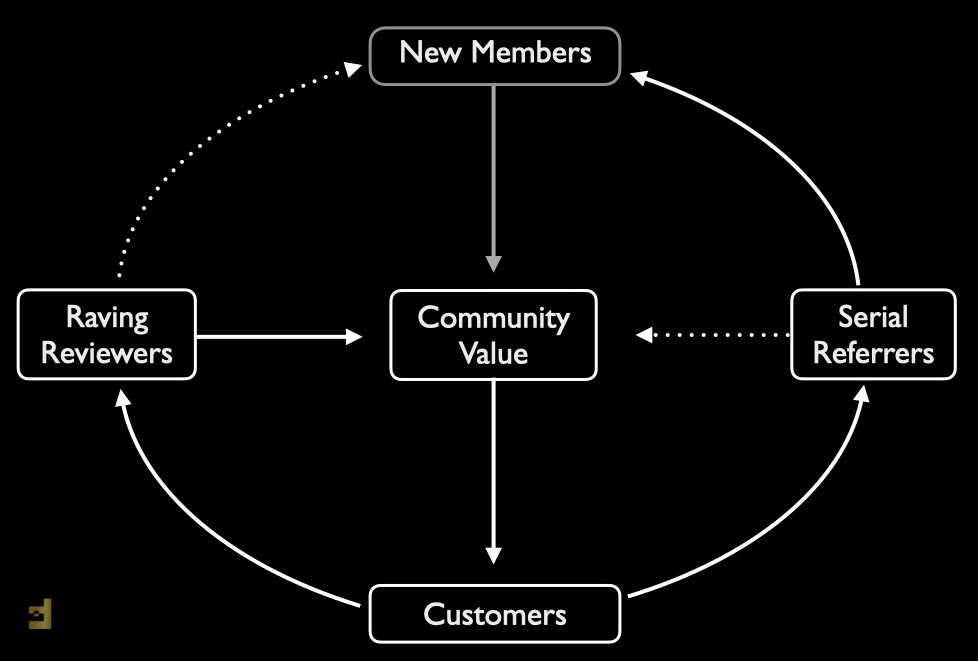
So now that you understand the customers you should be catering to and why they’re important to your business, let’s talk about the structure that facilitates the cultivation of all three with very little ongoing effort on your part.
Part 2 - Build It Right
“Effortless doesn’t come from laziness or luck, it comes from investing in the right systems”
When you’re setting up your community platform, there are 2 major things you need to do in order to increase the possibility each of your members becomes one (or more) of the 3 Rs.
Whether you’re building from scratch or upgrading your existing community, incorporating these two changes into your build makes life much easier for you going forward.
You no longer have to burn your energy spinning your wheels to create content that only 10% of your followers will see. You no longer have to rely on ad revenue or creator funds because your true fans have plenty of opportunity to purchase your solution(s). And you don’t have to spend every waking moment tracking down leads on social because your referrers are sending new members to your community regularly.
When a community is built properly, it does two things: (1) it makes it as easy as possible for your members to buy your stuff, and (2) it has effective incentive structures in place. There are multiple strategies that you can leverage for both, and you don’t need to use all of them. But as always, when they’re all stacked, they maximize the effectiveness and efficiency of the system.
Make It Easy To Buy Your Shit
This is the lowest hanging fruit for a lot of communities.
The simplest way to start reducing purchase friction is to leverage recurring payments like a subscription model, as mentioned before. This makes it easier for customers to pay you because it happens automatically every month or year, without them having to get their wallet out every time. Like I said before, use subscription models ethically, and only where it makes sense.
The next best thing to automatic payments is integrating checkout right into the hub. That way when a member purchases an offer, they never even have to leave the community.
And you can take this a step further by hosting your products directly inside your community. This is a pretty standard feature for community platforms now, and works especially well for digital products like courses, templates, guides, events, etc.
Now, whenever your members want to access their purchases, they’re not taken to some other platform that owns the relationship. Instead they stay right here, learning from the product you created in the environment you created, for this specific purpose.
But what if you haven’t created a digital product? What if you don’t have any native offers at all? Even if you’re only promoting affiliate offers, you can still make this happen to a degree. The best community platforms offer a sponsors/resources center which keeps all your affiliate offers in one place where your members can easily find them.
But that’s still not ideal, because your members are clicking links and going away from the community. Ideally, you want your members to be able to find, purchase, and access the offer all in one place. Luckily, cutting edge technology and the newest affiliate networks are enabling this to be a reality for affiliate marketers.
This is huge, even if you’re mainly focused on selling your own products. There is almost always at least one affiliate product you can integrate into your offers to earn some extra revenue with virtually no additional effort. That’s why I encourage everyone to at least consider incorporating affiliate marketing into their monetization strategy.
Now that you’ve made it easy for your members to purchase your offers right from your community, you want to focus on fostering a positive community environment. That’s where the first incentive structure comes in.
Build Effective Incentive Structures
Engagement Gamification not only makes community activity more exciting, it also makes it more valuable. Members earn points when they post or comment, and earn even more points when other members like the post or comment. This naturally rewards valuable content and the members that post it.
When a member’s accumulated points reach a certain threshold, they level up. Each level unlocks rewards automatically, including things like access to specific digital products, live events, private channels, exclusive groups, courses, coaching calls, etc. It’s best if access can be granted automatically as soon as the member levels up. These engagement rewards incentivize members to give to the community just as much value as they’re receiving.
The other great thing about this is that a lot of the people who are really gung-ho about getting points to earn these rewards, are usually not repeat customers. They operate more on the “free-to-play” mindset rather than the “pay-to-win” mindset. This gives your business a healthy balance of recurring revenue and community value.
Now that you’ve made it easy to buy your stuff, and incentivized quality engagement, it’s time to focus on bringing in new members to the community. To start, your best bet is using traditional methods like social media marketing or paid ads. If you already have an existing audience you can invite them to join using a lead magnet of some kind.
Once your community has a solid foundation of membership and value, you can implement the second incentive system - referral rewards. Just like members can earn points and rewards for posting valuable content, you can incentivize referrals the same way.
Each member gets a unique referral link, and any time someone joins your community from their link, that member gets credit. Just like with engagement gamification you can create multiple levels or milestones for members to achieve, unlocking increasingly more valuable rewards at every tier.
If you want, you can even give rewards in the form of cash or coupons. This does entail a slightly more involved set-up, but it’s incredibly powerful because this essentially acts as a cost-per-acquisition (CPA) model. Your referrers bring in new members, you pay your referrers a fixed rate per new member, and you never have to worry about losing money on marketing.
If you’re going to go the CPA route, I recommend making it the final milestone of your referral reward system. Give your members the opportunity to unlock other rewards like digital products first. This allows them to prove themselves as effective referrers, so you aren’t paying them until they’ve reached the final tier by referring a specific number of new members. From here on out they can continue referring and earn small rewards for each new member.
If you’re worried about people gaming this system or the engagement gamification system, just make sure you’re building your community on a platform with double opt-in enabled. That means when a new member signs up, they’ll be asked to confirm their email. This ensures only real people with real emails are joining, no fake accounts.
There is one more incentive structure you can implement, and it’s a natural progression from the referral incentive, especially if you’re using a CPA-type system. It’s totally optional and not for everyone, but if it makes sense for your business, it can be a complete game-changer.
The one downside of the CPA model is that if your community is free, your referral rewards have to be relatively low, since you aren’t technically making any money with each new referral. This isn’t really a problem if your customer lifetime value is high, but if you’re like me you want to make the rewards worth it for the people bringing you new members.
So the next step after a referral program is introducing an affiliate program. Now the serial referrers who have already been sending you new members, can start sending you new customers, and earning even more. Because when someone makes a purchase, now you are making money.
And because the sale happened as a result of a referral, it’s a sale you otherwise wouldn’t have made. So it’s a no-brainer to pay a healthy commission to your affiliate who made the sale for you (especially for digital products). Now you can afford to pay your affiliates commissions that make promoting your business worth their time even more.
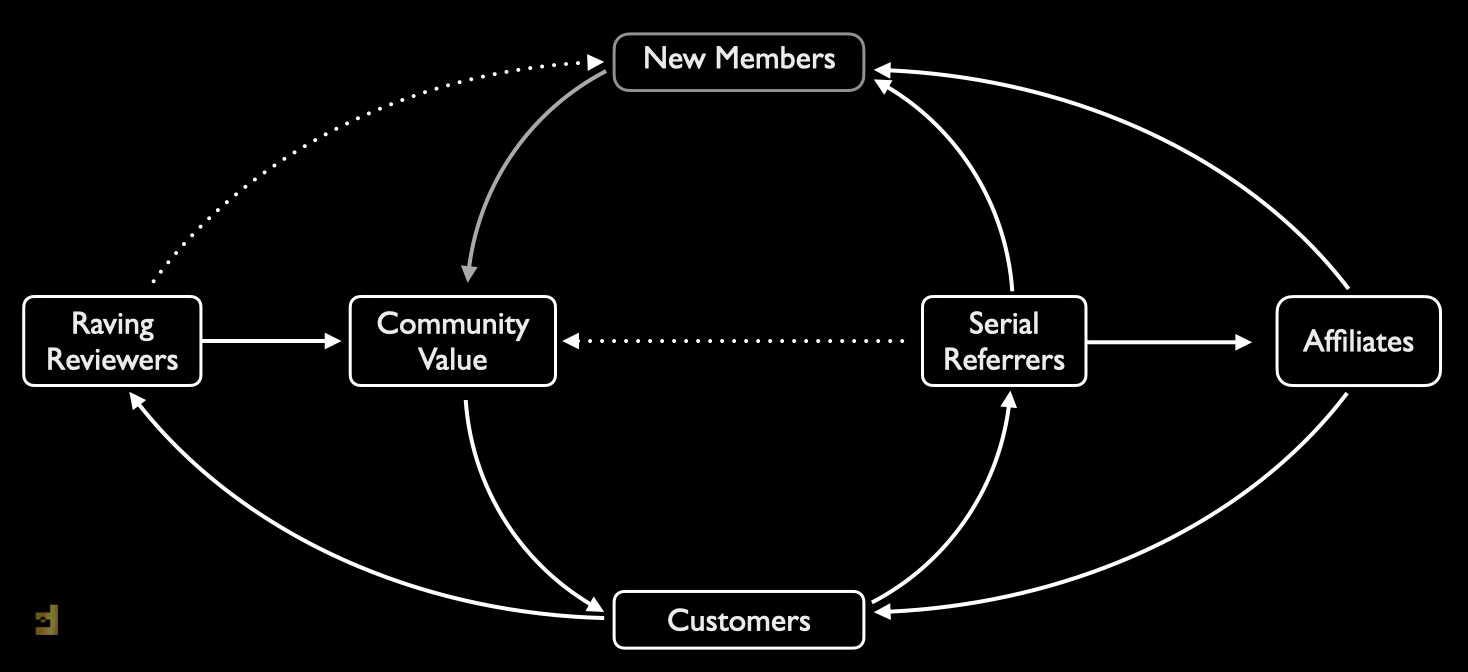
Just to concretize the power of these incentive systems: Engagement gamification alleviates some of the community hosting and value delivery burden on you as the community owner, because your members are helping you make the community a valuable place to be.
Referral incentives and affiliate programs are essentially free marketing. These people are sending new members and customers to your community without you having to even lift a finger. All you need to do is give them a small cut, so as long as you know your margins, you’re still making profit.
Obviously, one thing at a time. Start by building a community around a problem. Add some digital products and/or affiliate offers that help solve that problem. Integrate payment processing to make some of them paid products. Add engagement gamification and use your digital products as rewards for leveling up. Add more levels as your product library expands. Then you can implement a referral system and affiliate program to spin the flywheel even faster.
But how do you actually build it?
The Right Infrastructure
In an ideal world, you’d be able to incorporate all the components covered in the last two sections into your community with a single platform.
Now there are a lot of community platforms out there, each with varying degrees of capability in the context of this article. As far as I know, there is only one that has the ability to implement each and every component of this system on a single platform. (If you know of another, let me know in the comments)
The technology I’m familiar with (and use for my business) is called ESTAGE, and its different from all the other community platforms in one big way. It’s not a platform, it’s infrastructure. It allows YOU to build YOUR platform, instead of requiring you to rent your platform. That means the members in your community are YOUR members. Not Instagram’s, not Substack’s, not Skool’s. Yours.
ESTAGE gives you the ability to build a community platform right into your front-end website or blog. Make the community public, private, or paid; host products and affiliate offers natively; integrate checkout, including subscriptions and coupons; create as many engagement levels as you want, customize the rewards and rules to your heart’s content; do the same for the referral rewards; create affiliate programs baked right into your hub; and so much more.
If you’re ready to set up this insane customer flywheel for your business, I can’t recommend ESTAGE enough. It’s what I use, and I recommend it because I wouldn’t want to use anything else. You can learn more about ESTAGE here.
I’m sure there is a way to get this set up with other platforms, but it’s going to require multiple subscriptions (5-10 depending on the functionality you want) and lots of duct-tape integrations to make it functional. If you’re able to get a system like this to work, let me know, I’d love to see it.
However you decide to build, now you know what to spend your time on and which members propel your business forward.
Stop wasting time on the passive scrollers, social media haters, and dead weight email subscribers.
Focus your efforts on cultivating repeat customers, raving reviewers, and serial referrers.
Build infrastructure and incentive systems that automate that cultivation.
Then focus on your favorite part of the business.
Thanks for reading. Subscribe for more.
If you have any questions, come into the (free) VIP community and ask me there.
Talk soon,
Tim