

Good content can flop. Quality products can flop.
Even if it solves the problem better than any other product out there, if it’s not framed properly, it’s doomed to fail.
It’s the same with content.
Each piece of content is like a little mini product. The problem it solves is helping your audience shift their worldview on one particular point.
But if it’s framed poorly, it will get no engagement, no matter how good the actual content is.
No engagement. No leads. No sales. No income.
I previously wrote an essay titled Picking a Problem Worth Solving about how to select a focus problem to build a business around.
But the truth is that there’s more to it than just picking a problem.
No matter which problem you choose, that’s only the first half of the game.
The hard part is actually getting your audience to feel the pain the problem causes, and the urgency that pushes them to solve that problem.
Without feeling that pain and urgency, the audience has no reason to act and no reason to buy. If this is truly a problem worth solving you have to make them feel the need to solve it.
It all comes back to serving your audience. If you sell a solution to a problem, it’s your responsibility to get it into the hands of the people with the problem.
Of course, if and only if it’s in their best interests.
This essay is about the second half of the game.
The “Niche” Problem
In that Essay, I gave a very simple framework for choosing a problem. It’s either a Problem, Pain, Prevention, or Pleasure.
Pretty much any business idea worth pursuing can be put into one of those four buckets, or multiple, no matter the niche.
That’s important because a lot of the time people pick the problem based on the niche instead of picking the niche based on the problem.
So this essay will cover what to do once you’ve picked a problem.
Choosing your “niche” and making your audience feel the pain and urgency of the problem, so that they come to you to solve it.
Niche really isn’t the best word for this use case. Here I mean niche in a more broad sense, rather than the ultra narrow sense typically used by creators.
In 2026 the niche has been pretty played out.
People are no longer scrolling social media for someone with hyper-specialized and ultra-focused content. They’re scrolling social media for relatable people who have solved relatable problems.
The best niche you can choose in 2026 and beyond is your own niche.
A niche of one. You are the niche.
Everyone has their own unique set of influences and perspectives, which leads to inherent uniqueness in creators’ worldviews and content.
I won’t go into too much detail here, if you want more on becoming the niche, you can check out the brand canon essay.
The “niche” we’re talking about today is more of a foundational direction toward that ultimate one-person niche.
It will point you in the right direction of your own niche without stifling most of your good ideas.
The Big 4
There are 4 main niche areas: health, wealth, relationships, and happiness.
People are significantly more willing to purchase a product or service if it’s a solution that will solve a problem in one of these areas.
Wealth
People are usually willing to pay for something that has the potential to make or save more money than it costs.
As I talked about in Become Dangerously Autonomous, money is a resource used to participate in society.
Growing or protecting wealth increases financial autonomy and therefore personal agency.
And it unlocks solutions in the other 3 categories as well.
Health
Health will always be a high priority for people with purchasing power.
Regardless of the benefits of money, you can’t take it with you when you leave this world.
So it’s better to put that money to use extending your time in it.
Relationships
Arguably more important than the length of your life is the people you fill it with.
Our relationships (platonic, romantic, familial, professional, etc.) are the sources of some of the most beautiful and the most painful experiences of our lives.
Helping your customers solve problems in this area can greatly improve the quality of their lives, and yours, making relationships another high priority area.
Happiness
And of course if you’ve solved all your problems in those 3 areas, there’s not much left but to focus on your own happiness and experiences.
This area is arguably slightly lower priority than the others, but most people will spend some amount of money on some level of happiness no matter where they are on the financial autonomy scale.
The Frame
Every solution fits into one of the Big 4, and is one of the 4 P’s.
Depending on the problem, your solution may pertain to one or more of these areas.
No matter what it is, you can find a way to frame the product as a solution through one of these 4 lenses.
When you’re evaluating your options, you’re really looking at this 4x4 grid. Your problem fits into one of those 16 cells.
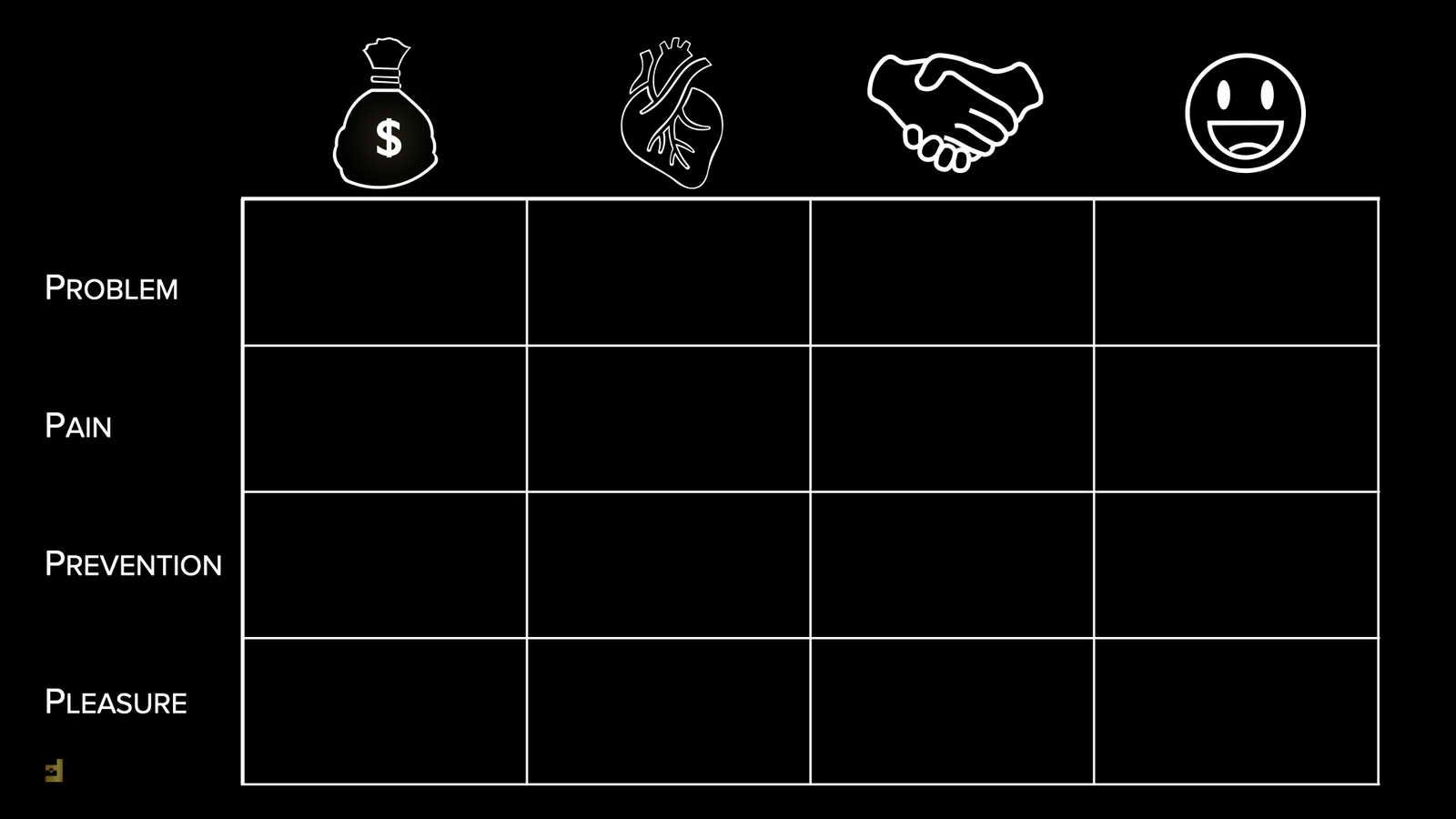
But figuring out which cell it’s in is just the first step.
Now your job is to illustrate to your audience why it’s important to solve the problem.
What problem do you solve?
Why is it important for your audience to understand it?
Why is it important to solve it?
The cell your solution fits into has coordinates, and those coordinates give you a cheat sheet for how to frame your product.
For example, acetaminophen is just a jumble of letters until it’s framed as pain relief for physical injuries.
You don’t sell what’s in the bottle, you sell what it does.
Here are a few more examples to illustrate the point.
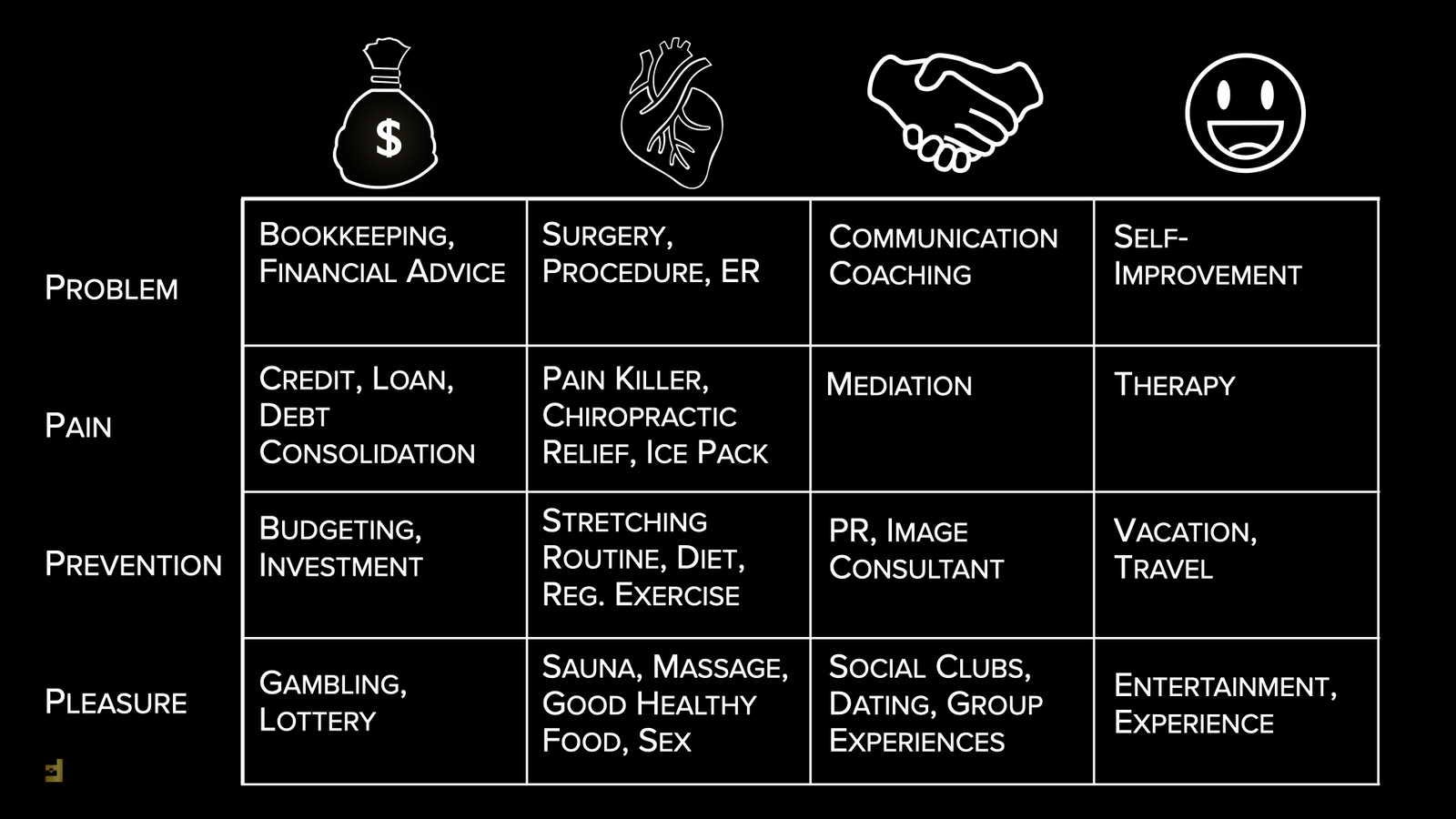
As you can see some solutions can actually fit into multiple cells. This gives you multiple angles to work with.
Feel The Pain
“If you can articulate someone’s pain better than they can, they will believe you have the ability to solve it.” —Alex Hormozi
Once you’ve selected your problem and determined which lens to frame your solution through, you have a much better idea of how to make your audience feel the pain.
And not just in the pitch.
In all your copy and content as well.
In your emails and your ads, in your webinars and VSLs.
Anywhere and everywhere you communicate with your audience, you must illustrate the pain.
There are a number of ways to do that, and we’ll go through examples of these tactics shortly.
But you need to understand the underlying principles in order to use them strategically.
Making the pain be felt is a 4 part process. We’ll call it the APII framework
1- Get their Attention
2- Communicate the Problem
3- Communicate why it’s Important
4- Illustrate the pain with an example or analogy
APII is the blueprint for framing the problem. Use the tools below to actually build it.
Getting Attention
Pattern interrupts are one of the best ways to get people to pay attention to you.
A social media post, or subject line, or sales copy, that goes against what they are conditioned to expect from that content is much more likely to grab attention and stop them from scrolling.
Using specific numbers in your headings, titles or posts is a great way of doing that.
Numbers jump out from the page and push the audience to actually read the sentence the numbers are in. You can use them in many forms from metrics and statistics to dollar amounts and timeframes.
The perfect example is the listicle with headlines like “This 6 step morning routine…” or “20 pieces of advice for people who…” or “Top 15 must see destinations in…”
Negativity Bias is an excellent tool for capturing attention.
It plays on our brain’s natural tendency to react more strongly to negative stimuli (experience, emotion, information) than positive stimuli of equal magnitude.
“Everyone wants to be successful” vs “Nobody wants to be a degenerate”
Communicating The Problem
You can also call out the problem outright, which takes care of step 1 and 2 simultaneously.
Most problems are experienced by many people. If you can communicate the problem to them well you have their attention.
A more direct way of getting their attention is to call out the target audience directly, rather than the problem. For example:
“If you’re a creator writing short form posts for X and Substack, the target callout is your best friend.”
Communicating The Importance
Rather than calling out the problem or the target audience, you can lead with a benefit instead.
What is the payoff?
How soon can they see results?
What type of results can they expect?
What obstacle will they be able to avoid?
(“Without” is a good word to use for that.)
Be sure it’s actually a benefit and not a feature. People want what the product does, not the product itself.
Warn your audience what happens if they don’t solve this problem?
What are the consequences of leaving the problem unresolved?
Illustrating The Point
Social proof is the most direct way to illustrate the problem and your product’s ability to solve it.
Reviews and testimonials relieve uncertainty in the customers eyes. If you can show it worked for people before, they become more confident in your solution.
Stories, examples, and demonstrations are a good alternative if you don’t have reviews or testimonials.
Tell the story of how you discovered the solution. Or the story of someone who really needed the solution, and how it improved their life.
Show them how the product can be used in different use cases. Show them how the product works so they can see how it can solve their own problem.
And you don’t have to physically show. Sometimes you can’t. But you can always show it with words. Illustrate.
Metaphors and Analogies are excellent tools for this.
Not only do they help the audience see the point from a new perspective, but they also help you see it more clearly as well.
I find metaphors and especially analogies open up new pathways of thought about an idea or topic.
Best Practices
No matter where you apply these principles (and you should apply them everywhere you communicate with your audience) your communications should be easily consumable.
Your social posts, emails, ad copy, all of it should be formatted for readability. It should be easy on the eyes and aesthetically pleasing to a certain degree.
Your communication is most effective when you do it with confidence and conviction in what you’re talking about or writing about.
If you don’t have confidence in your product’s ability to solve the problem, you’re selling the wrong product.
Sell only what you trust to solve the problem.
Make It A Habit
If you don’t get attention, you’re speaking into the void.
If you don’t communicate the problem, your audience has no reason to care.
If you don’t communicate the importance, they have no reason to take action.
If you don’t illustrate the point, they won’t feel the need to solve the problem.
Your content will flop. Your products will flop.
You’ll just keep spinning your wheels with nothing to show for it.
But now you know how to frame your offers and content to make them feel the pain.
Use the grid. Use the 4 step process. Everywhere you communicate.
Take whatever offer you’re selling or thinking about selling, and see where it fits best on the grid.
If you aren’t selling an offer yet, you can use the grid to evaluate which areas resonate with you.
The more you resonate with the problem/solution frame, the less you will have to “sell” and the more you will just naturally serve.
And any time you have an idea for a product, a business, a piece of content, whatever, check the grid to see which frame fits best.
After a while this will become second nature and you wont need the grid anymore because it will be burned into your brain.
A good exercise to get there is to sit down with an empty grid and fill it up. with your ideas, with other ideas you’ve seen, with new ideas that pop into your head.
The more you stimulate this part of your brain, the more innate the “business idea” skill becomes, and the more intuitively you’ll be able to frame your offers and content.
If you’re looking for help or feedback on your ideas, come ask your questions in the Future of Freedom VIP Community. It’s for anyone looking to build independent income online and it’s free to join.
See you inside,
Tim
Thanks for reading. Subscribe for more.