

Everyone has a vision for the future, but few have the means to make it a reality.
That’s because most don’t realize it’s up to them to develop the means themselves.
Right now, a car with no steering wheel and no pedals is shuttling people around Austin, TX for paid fares.
It was never given formal approval to exist in its current form, and yet it’s not breaking any laws.
The rules were written for a vehicle with a driver.
So what happens to the rules when there is no driver?
Elon Musk is pushing his vision into reality, regardless of the obstacles in the way, and most of the world isn’t even ready for it.
This is how he operates. He consistently straddles the gap between what the world is ready for and what the world needs.
You have a vision for the future too.
You might not call it that, but there is a world you would rather live in than your current reality.
What you’re missing is the means to make that world into your current reality.
That’s what this article is for.
Elon is the prime example of dangerous autonomy.
I don’t agree with everything he says or does, and I don’t expect you to either.
But there is something we can learn from him, a process he used (and still uses) to foster dangerous autonomy.
This article breaks that process down into three steps so you can apply to your own life to cultivate your own autonomy.
The Ability to Get What You Want
Dangerous Autonomy - The means to solve massive problems in service of your own vision as a result of relentless removal of dependencies.
While it may seem like Musk is just doing whatever the hell he wants with no regard to regulations, this entire operation (and all of his companies) is not only within the existing legal limits, but also pushing them forward.
Tesla has self-certified Cybercab, an industry-standard practice. But it’s usually evaluated on drivers’ safety. What happens when there is no driver?
The NHTSA opened an investigation into the self-certification, requesting massive amounts of documentation quickly, which Tesla is cooperating with.
The question is not whether Tesla is breaking the law with Cybercab.
The question is whether or not the existing laws are fully applicable to a completely new kind of vehicle.
The safety regulations are written with a specific intent - to keep the driver and occupants safe.
The NHTSA is trying to determine if a vehicle can legally satisfy the protective intent of driver-centric rules when the physical parts meant to execute that protection are missing.
For instance, there are lots of regulations around airbags because that’s an incredibly important safety feature. They are especially important around the steering column because that’s where the driver’s main airbag is housed.
Airbags are engineered to deploy relative to the location of a steering wheel and a forward-facing driver. With the steering column removed, the physics of cabin impact safety change completely, which requires entirely re-engineering how occupants are restrained.
The good news is Tesla has done this.
The Cybercab has far more airbags than the standard 2-seat vehicle, and is designed to protect passengers in a variety of positions beyond sitting. The nature of the cab being autonomous will change how people occupy it.
So the NHTSA investigation is not proof that Elon breaks the rules to do what he wants.
It’s proof that he is operating within the existing regulations to achieve a vision as expediently as possible.
This is what it means to be dangerously autonomous.
The ability to pursue your own serious undertaking, under real rules, with enough independence that a single entity cannot stop you.
Dangerous means consequential, not unlawful.
This trait is responsible for and manifests itself in every one of Musk’s ventures.
And it wasn’t his billionaire status that unlocked this trait, but the trait that unlocked his billionaire status.
There’s a 3-part process Elon has applied to every single one of his projects.
And it starts with a single sentence.
Pt. 1 - The One Sentence Reality
Become a spacefaring civilization, preserve the light of consciousness and create an exciting future.
This is a paraphrased reduction of the SpaceX mission.
Everything that SpaceX does is in service of this vision.
Starlink’s mission is to provide connectivity for everyone on earth, in the air, and in space.
Starship is the vehicle that puts those satellites in space, and will eventually bring colonization infrastructure and the colonists themselves into space.
Starbase is the launch facility Starship will launch from, reportedly thousands of times per year. Starbase, Texas is actively sending Starlink satellites into orbit, but only has 2 pads.
SpaceX just announced plans to build their next-gen spaceport (with 10 pads) in Vermilion Parish, Louisiana and is using it as an excuse to take on a massive environmental restoration project.
This one sentence isn’t just a mission statement. It’s a vision.
It’s a lens through which Musk passes every decision, every project, every ambition.
And it doesn’t just apply to SpaceX.
Every single one of his companies’ missions serves this vision.
Tesla’s mission: Building a world of amazing abundance
xAI’s mission: Accelerate human scientific discovery to extend what humanity can know and do
The Boring Company’s mission: solve traffic, enable rapid point-to-point transportation, and transform cities
Neuralink’s mission: Restore autonomy to people with unmet medical needs today and unlock human potential tomorrow
Each one contributes to making that one sentence a reality in at least one way.
And this vision has been constant throughout Elon’s life.
He often recounts how as a kid he was upset that we went to the moon, but never went further, and even stopped going back.
Even before he founded SpaceX, he had the vision of sending a greenhouse to Mars and beaming back a photo of a green plant on a red planet.
That would be enough to reignite the excitement and motivation for space exploration, which is necessary to make humanity spacefaring.
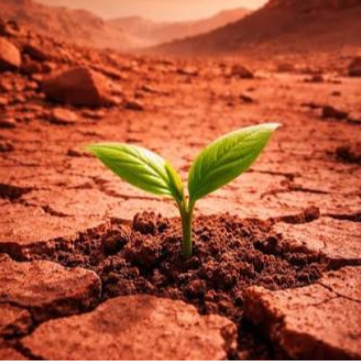
This is the vision that kicked off his entrepreneurial journey.
It’s the one that took him to UPenn to get a dual degree in physics and economics, and eventually to Stanford to pursue a Ph.D. in materials science and applied physics.
Compressing your vision into a single sentence can be difficult. First, spend some time getting clear on your vision for the future. What world do you want to live in? Then reduce it to its core essence.
This becomes a decision framework for every challenge you take on.
Pt. 2 - Financial Autonomy
To fully understand how this level of dangerous autonomy was cultivated, we have to go back to the start of his entrepreneurial journey.
Musk often recounts how as a college student he challenged himself to live on just $1 a day. That was his first foray into financial autonomy.
And it proves that everyone starts somewhere, even the most autonomous man in the world.
But the financial autonomy really kicked off at Stanford in 1995.
Elon was not 2 days into grad school before he decided to drop out and try to capitalize on the internet boom.
He and his brother Kimbal and Greg Kouri launched Zip2, which provided online business directories, maps, and city guides for newspapers.
Receiving initial capital from angel investors and a later investment from a large VC firm, they began licensing the software to major papers like the New York Times and Chicago Tribune.
In February 1999, Zip2 was acquired for $307 Million, of which Elon received a $22 Million cut for his 7% share.
22 million dollars would be enough for most people to ride off into the sunset. But Elon looked at his one-sentence reality and knew it wasn’t a reality yet.
So he kept going.
Just one month later, he uses about half of that 22 million to co-found x.com, an early online banking platform pioneering email-based money transfers.
A year later, x.com merges with Confinity (Peter Thiel) to acquire its popular money-transfer tool, PayPal.
After some disagreement, they rebrand as PayPal, and in 2002 eBay acquires PayPal for 1.5 billion.
Musk, being the largest shareholder, collects $180 million. 8x the size of his Zip2 paycheck. Again, enough for anyone to ride off into the sunset. Eight times.
But not Elon.
Humanity is still not a space-faring civilization, so there is more work to do.
Six months before the PayPal-eBay deal, Musk uses 100 million of his expected payout to found SpaceX.
From spending a $1/day to investing 100 million dollars into his own space company, in 12 years.
Clearly the man has ambitions and executes like a madman to achieve them.
And it would not be possible without the financial autonomy cultivated over the course of these early ventures.
You don’t have to live on a dollar a day or sell a startup for $307 million. Start by eliminating the unnecessary costs. Then focus on building something valuable.
So part 1 of the process is having a clear vision. Part 2 is cultivating the financial autonomy necessary to bring that vision into reality.
Part 3 is engineering like crazy.
Pt. 3 - The Triple Engineering Loop
Once a project has been determined to support the ultimate vision and the funding has been secured, the engineering begins.
And it happens in 3 parts.
First, tackle the problem. Engineer the solution from the problem. Second, apply engineering to the solution until you have a viable product. Third, apply engineering to production until the product is mass scalable.
Let’s look at it through the lens of SpaceX progression.
Round 1 - The Solution
When Elon founded SpaceX, the biggest obstacle to becoming a spacefaring civilization was that it was incredibly expensive to put something in orbit.
In the space shuttle era, it cost about $55,000 to send 1kg to orbit.
To be a true space-faring civilization, you need a lot of kgs in orbit. Musk hypothesized that it could be solved with reusable rockets.
Instead of crashing the vehicle every time you use it, you bring it back, clean it up and use it again, the same way airplanes work.
Everyone deemed it impossible. And it was a huge engineering challenge.
First, an infantile space company has to figure out how to build a rocket. This took 4 tries and almost bankrupted the company.
But the fourth launch of the Falcon 1 rocket was successful and kept SpaceX alive, making SpaceX the first private company to launch a liquid-fueled rocket to orbit.
Now the “impossible” part. They had to figure out how to make the rocket reusable.
To do this SpaceX developed the Falcon 9.
The first stage booster is designed to send the second stage to orbit and deploy the payload (like a normal rocket).
Then return to the launch site with pinpoint accuracy, fire up its engines, come to a hover right above the ground and land vertically (unlike a normal rocket).
Then the booster is refurbished before it’s next launch.
Nobody but Elon and SpaceX thought this would work. And even Elon wasn’t certain.
But in 2015 the first falcon 9 booster landed successfully, and since then, SpaceX has made this launch-land-refurbish-relaunch cadence the norm.
This has brought the cost to orbit down from $55K to around $3,000 per kg.
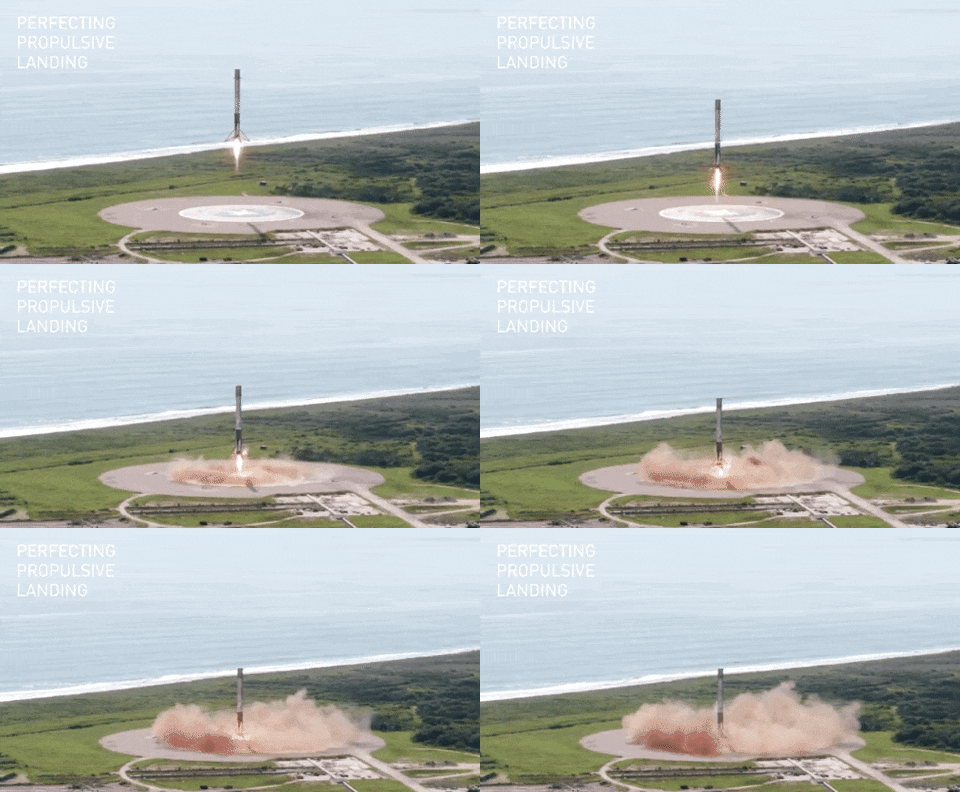
So they’ve engineered the solution to the problem - a reusable rocket.
Now they have to apply engineering to build the best product from that solution.
Round 2 - The Product
Falcon 9 is completely revolutionary, but it has a lot of shortcomings.
Only the first stage is reusable, so every flight requires many new parts. And the payload capacity is relatively limited. Good for small satellites, not enough for large infrastructure.
And refurbishment is still slow. They’ve gotten the process down to weeks (compared to the months it took to refurbish the space shuttles). But to launch 1000x per year as Musk states is necessary to bring the colonization infrastructure into space, it needs to be much faster.
Enter Starship, SpaceX’s next-gen rocket, designed to be fully and rapidly reusable, with over 5x the payload capacity of falcon 9.
At these specs the cost to orbit is expected to fall to $100 per kilogram. (remember the space shuttle cost $55,000/kg)
Starship has already successfully reached orbit and deployed its first functional payload.
But this is only the second engineering pass.
Round 3 - The Production
An optimal product is not enough. It must be scalable.
The third pass applies the engineering not to the product, but to the production of that product.
SpaceX eventually wants to produce 1000s of rockets.
This is an insane target. Anyone familiar with rockets knows that it’s usually a years- or decades-long process to produce one rocket.
Even SpaceX only produced 13 Falcon 9 boosters per year at peak production rate.
So this will require a massive production engineering effort.
Now that the overall design has been mostly finalized, they must shift to optimizing production, and Starfactory is their answer to that challenge.
This factory was designed from the ground up to produce starships as efficiently as possible.
But producing the starship is only part of the equation.
To launch 1000s of starships per year, they need to produce thousands of starships, but they also need to be able to launch that many.
That’s where Starbase Louisiana comes in.
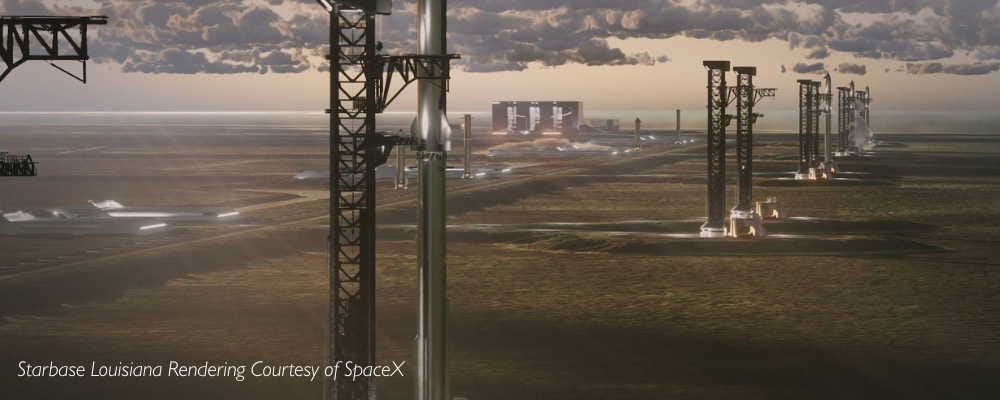
Scaling is a different skill than building. When you build the machine that builds the machine, you become unstoppable.
But you don’t need to solve an Elon-level problem to use this process. You just need to solve a problem. There is no problem too small to solve, and no solution too small to scale.
This triple engineering loop has been used in practically every musk venture: Tesla production vehicles, cybercab and unboxed manufacturing, the boring company and its boring machines, optimus, the starlink satellites, and everything else.
This guy honestly does too much. There is so much ammunition to support this process, I could turn this article into a book.
With great autonomy comes great responsibility
Dangerous autonomy is not all sunshine and roses.
Ambitions this large come with challenges just as big. Engineering challenges, legal challenges, partnership challenges, political challenges, reputability challenges, even financial challenges. The list goes on.
Musk is not immune to any of these. He has shown that approaching those challenges with this process allows you to achieve the impossible.
He has done it so many times now, it’s practically second nature. A few weeks ago, Elon put on the wildest display of dangerous autonomy.
Yes, I’m talking about the roadster demo.
The man literally took rocket thrusters from his space company and strapped them to a car from his car company, and made it fly.
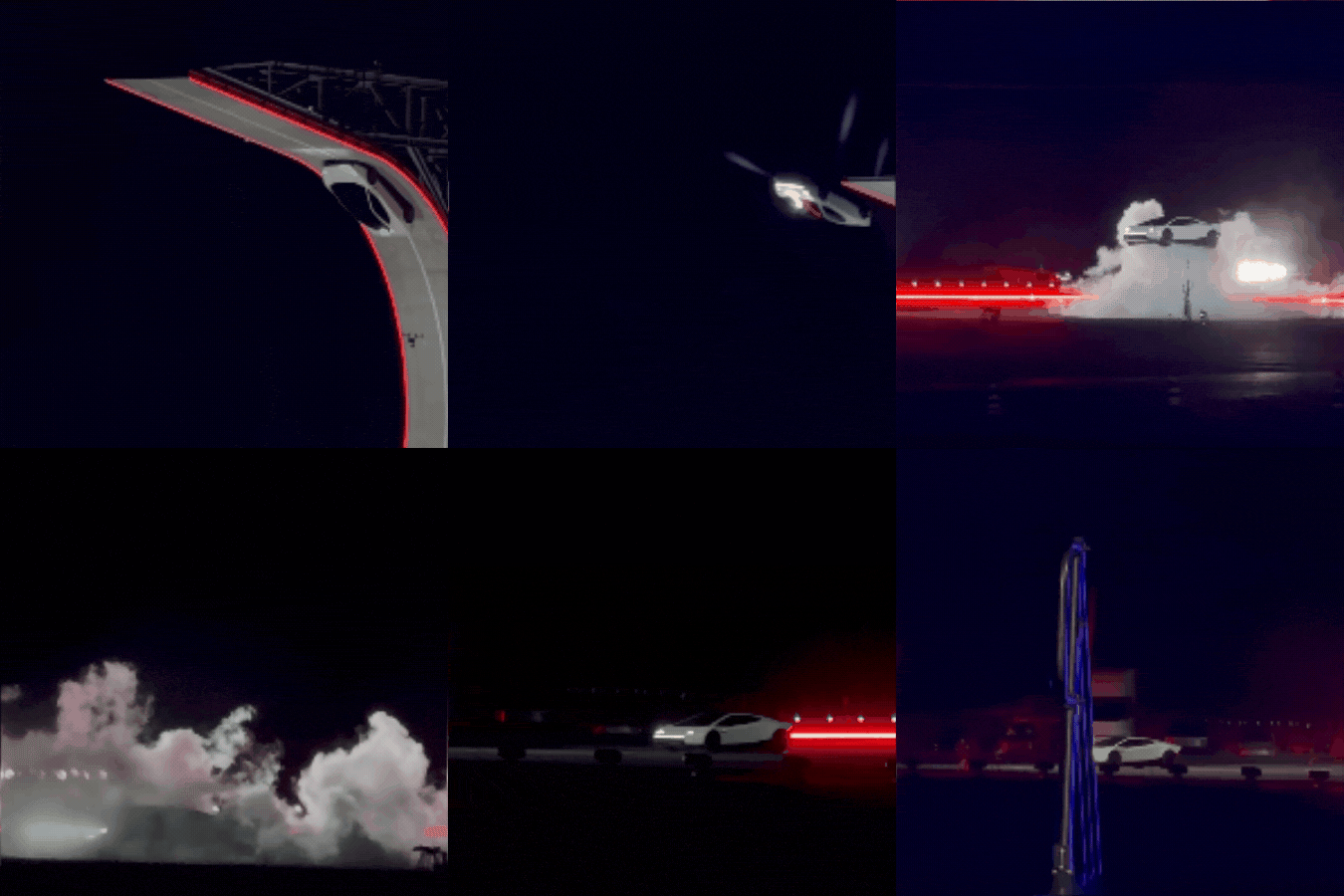
And this is a car that will likely never be road legal.
Elon said it himself. Tesla’s revenue does not depend on the roadster.
“But Roadster is super cool, so we’re doing it anyway.”
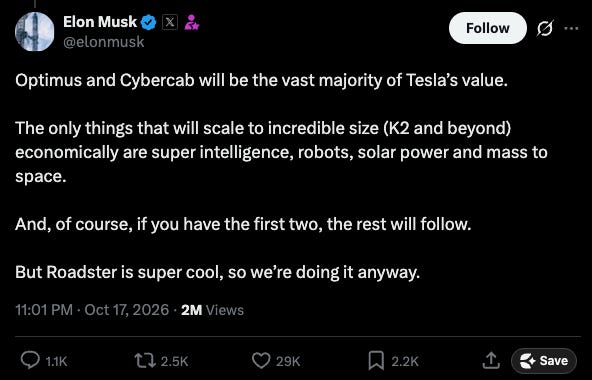
Whether you love him or hate him, whether you think the roadster is cool or trash, you have to admit that’s a hell of a use of free will.
To have the financial and engineering resources to build a flying car “because it’s cool.” If that’s not dangerous autonomy, I don’t know what is.
Are you going to build a rocket-powered sports car? Probably not.
But there’s something else.
Something inside you that you know you’re destined to create. Something the “real world” has deemed impossible, or pointless, or delusional, that you know you can bring into reality.
Copy Elon
Talking about driverless taxis, billion-dollar rocket companies, and flying cars might make this seem out of reach.
But you can start cultivating dangerous autonomy with the same 3-step process Elon used to get where he is today.
Get clear on your one-sentence reality. What is the future you want to live in?
Start cultivating financial autonomy. You don’t need to make a $300M exit for this. Start small by eliminating the dependencies that govern your life right now.
Identify a problem and formulate a solution. Turn that solution into a product. Then scale.
You are not powerless. You can cultivate this kind of autonomy too.
If you want to go deeper on your one-sentence reality, I break down the mechanism in more detail in my previous newsletter: The 2-Part Cycle that Makes Every Decision Obvious
If you resonated with this article and want to start building your own autonomy, join the Future of Freedom VIP Community.
Connect with like-minded people and build your future of freedom together.
See you inside,
Tim
Thanks for reading. Subscribe for more.