

It’s not gatekeeping, it’s cyclical wantrepreneur burnout.
And it’s not your fault.
Almost everyone in the online business space has experienced this to some degree.
You tire of your current monotonous existence as a corporate drone, so you do some research on generating income independently.
After digging, you come across an idea that seems like it could actually work.
You hem and haw, but the math checks out and it seems like this is not only your best option, but your only option.
So you bite the bullet and invest. You start on the first module and it’s even better than expected.
You move on to the second module, and the third after that, continuing to soak up all the information available until…
That’s it. It’s over.
You’ve finished the course material and now you can see it clearly.
The actual mountain you have to climb before you can reach the summit that was originally promised.
And that mountain is much bigger than anticipated.
You start to second guess if this strategy is all it’s cracked up to be.
Now that you can see all the hurdles and challenges and obstacles that are a part of this journey, you question if all the answers are just hiding behind the upsell’s paywall.
Rather than continuing to shell out for the information that was promised to you from the beginning, you wonder if there isn’t some other method out there.
A better, more efficient and effortless method that would deliver you from your current reality much faster.
So you do some research, and wouldn’t you know it, you come across an idea that seems like it could actually work.
And the cycle repeats.
There’s an underlying pattern that perpetuates this cycle.
A pattern most people are completely unaware of.
It’s the root cause of not only the frustration that comes from attempting a new strategy, but also the self doubt and the opportunity-hopping pressure (what I call “hopportunism”).
Once you actually acknowledge this pattern, breaking it becomes much more trivial.
But before we get ahead of ourselves, you first have to understand the cycle and where it shows up.
The Valley of Despair
The Valley of Despair is not a new concept. It’s been around for decades as a component of other frameworks, most notably the Dunning-Kruger Effect.
Dunning-Kruger Effect
The Dunning-Kruger Effect describes a cognitive bias where people with limited experience in a given skill or subject matter overestimate their knowledge or ability to perform that skill. They don’t yet have enough exposure to know how much more there is to learn.
This results in an early peak in confidence relating to that skill or subject, that gradually declines over time. The more time you spend on it, the more you realize the true depth of the subject. The peak in confidence is referred to as “Mount Stupid” and this low point is the Valley of Despair.
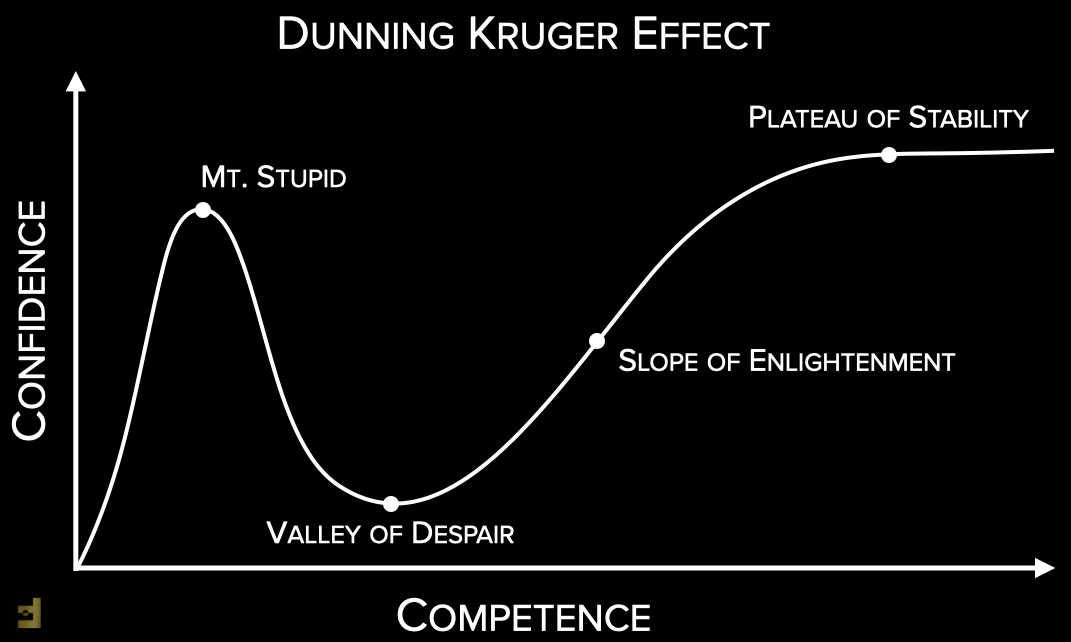
Even though you’re more proficient than you were at peak confidence, what’s peaking now is your self-doubt. But keep pushing through the valley of despair, and you’ll find yourself on the Slope of Enlightenment. It’s an uphill battle, but with each small win you regain some of that confidence, until you finally achieve your initial goal, and your confidence levels out on the Plateau of Stability.
The Learning Curve
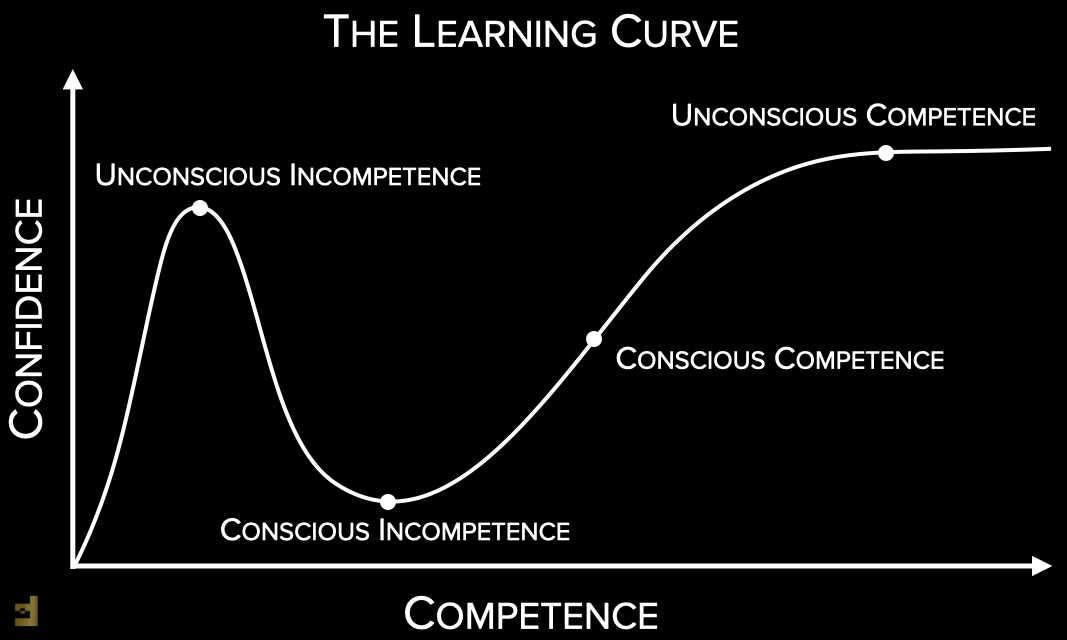
We can see a similar pattern in the 4 stages of learning. It begins with unconscious incompetence, when you don’t know how to do the skill, and you don’t know that you don’t know how. This parallels mount stupid from the Dunning-Kruger Effect.
This is followed by Conscious Incompetence, which is when you realize you don’t know how to do the skill. This is when the graph begins to dip into the valley of despair. The uphill battle is Conscious Competence, where you can perform the skill but you have to think about every single step.
The final stage is Unconscious Competence, when the skill becomes natural. You can enter flow state and perform the skill without even thinking. This is the plateau of stability.
5 Stages of Entrepreneurship
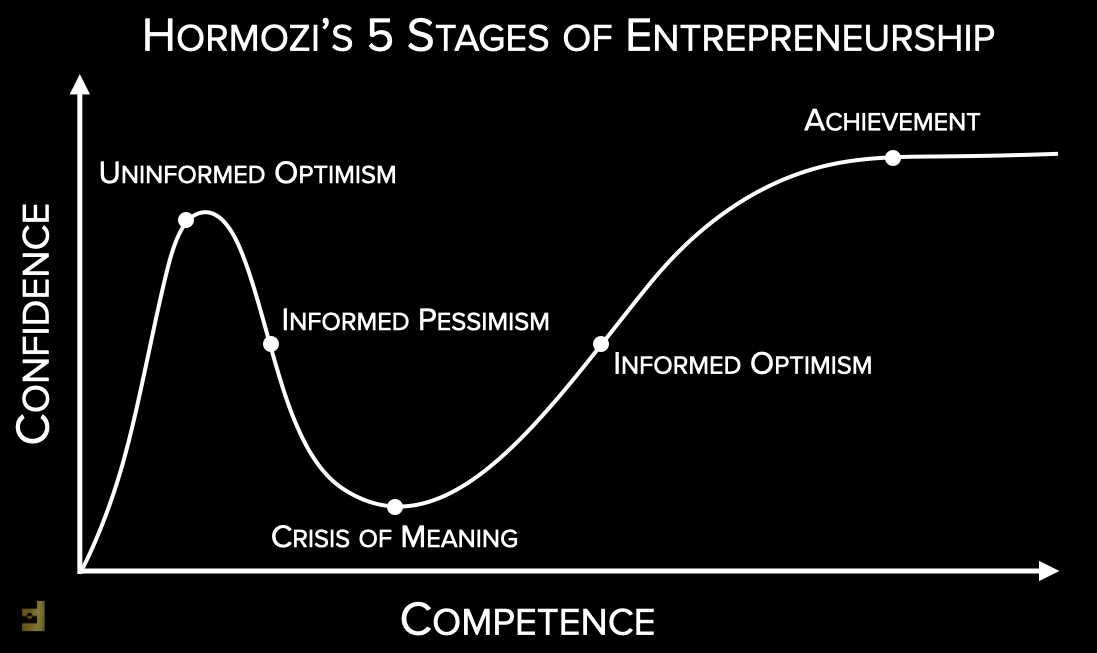
You can start to see how this pattern applies in the case of shiny object syndrome when you look at Alex Hormozi’s 5 stages of entrepreneurship:
He names the stages Uninformed Optimism (familiarity with the pro’s but not the con’s), Informed Pessimism (learning about the con’s), Crisis of Meaning (aka Valley of Despair, when you see the size of the mountain you have to climb), Informed Optimism (you know what it will take and you’re willing to do the work), and Achievement.
5 Stages of Grief
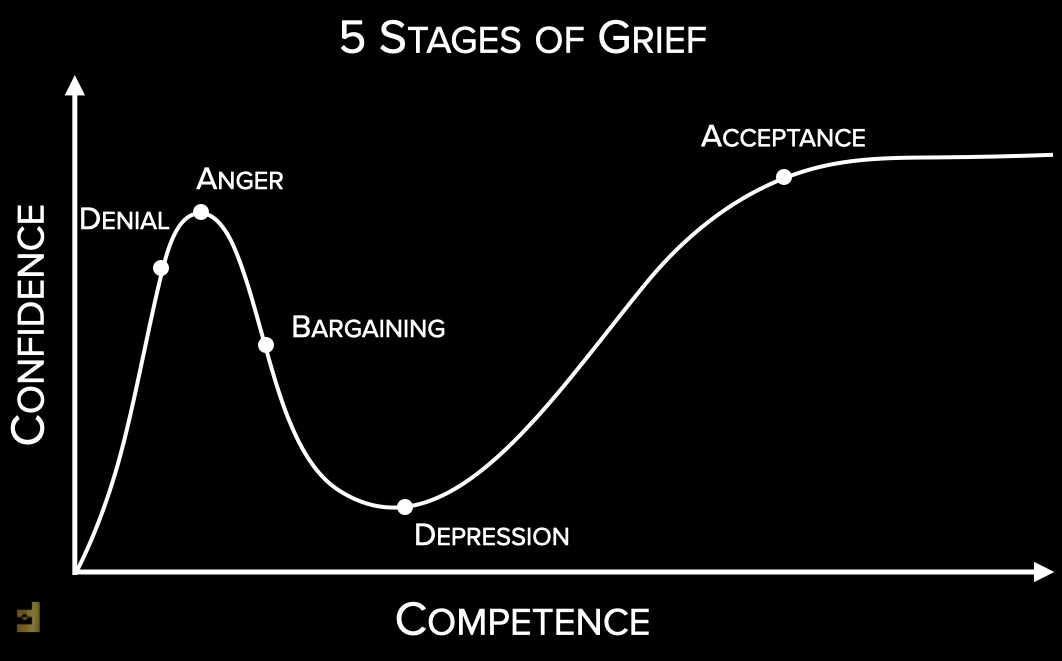
The same pattern can also be found elsewhere, such as the 5 Stages of grief, traditional American names for the grades in high school and college, and arguably, even in the hero’s journey, though it is a bit of a stretch.
In the 5 stages of grief, denial aligns closely with uninformed optimism. “I can just tell myself everything is fine, and everything will be fine.” Anger lives at the peak of mount stupid and bargaining begins the steady decline into the valley of despair. Depression is the uphill battle, and acceptance is that plateau of stability.
High School & College
In America, the 4 levels of high school and undergraduate college are Freshman, Sophomore, Junior, and Senior. Freshman is intuitive, with fresh in the name, and junior and senior are also relatively intuitive hierarchically. The junior year was always my most challenging year and I often hear the same from others, so it fits nicely in the valley of despair (much to the chagrin of my 16 year-old self).
But the real reason I include this example is for Sophomore, the only not-obviously-intuitive one of the four. It’s a Greek word coming from Sophos, meaning “wise” and Moros, meaning “foolish.” So the word sophomore literally translates to “wise moron” and was named such because most students in their second year are somewhere near the peak of Mount Stupid.

Hero’s Journey
The hero’s journey begins with a call to adventure and mentorship, which align closely with uninformed optimism. Upon departure, the hero begins encountering challenges, some of which make them question their ability to complete the quest. This is the downward slope.
The crisis or ordeal sits in the valley of despair. This is the true test. If it were a normal person in the hero’s shoes, they would give up, quit, or fail. At a certain point, even the hero doubts their own ability to overcome this test. But they push through, achieving the victory and beginning the journey home. The return chapter lines up with the slope of enlightenment, and the final chapter, Transformation, fits right into the plateau of stability.
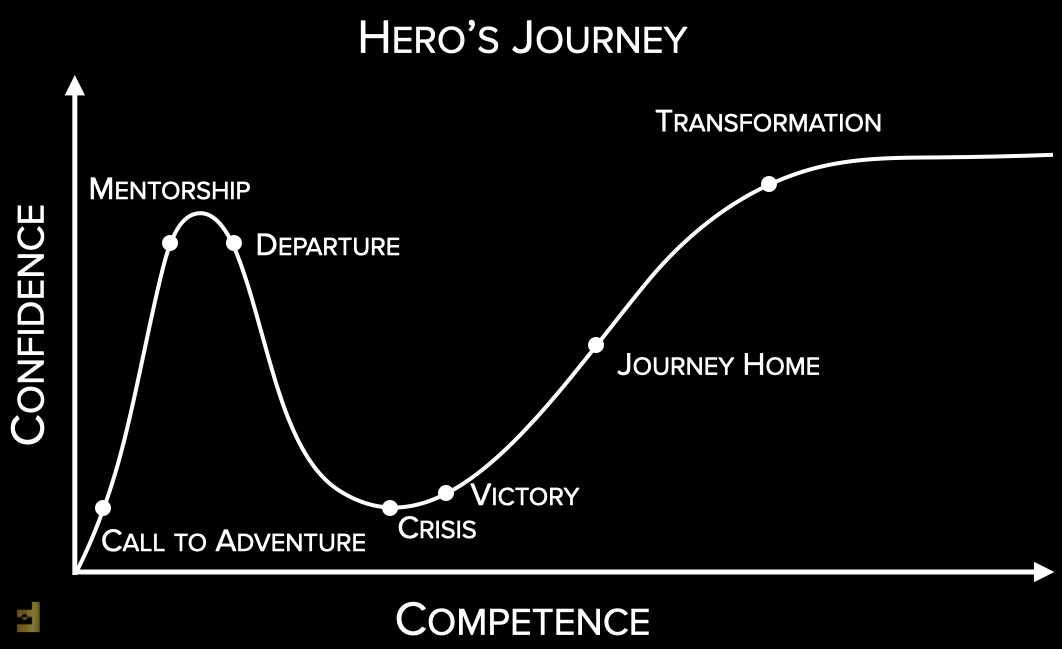
So clearly, we’re working with a pattern here, and the simple reduction is 5 stages of Optimism, Frustration, Despair, Determination, and Success. The trap that most people fall into is the valley of despair. Simply knowing it’s a part of the process and not necessarily the end of the road makes it much easier to continue pushing through.
But the valley of despair is not without its symptoms, and there’s one in particular that’s the single biggest road block keeping people from the slope of enlightenment and achieving success.
Imposter Syndrome
More often than not, you are your own biggest obstacle.
The valley of despair is a bout of low confidence that comes as a result of more accurately assessing the horizon of mastery. This is when you finally understand what it’s going to take to reach your desired level of success, and that it’s more involved than the shiny-object marketing made it out to be.
In the valley, you think you are less of an expert than you are. Experience is higher than confidence, so you have something to offer but you think it’s worthless. If you’ve ever been on a hike with a false summit you can relate on a physical level.
You’ve been hiking for hours and you finally see the top, a peak with nothing but sky beyond. Until you actually get there, and realize the real summit was hiding behind it. You’re just a sophomore standing on mount stupid. You had your hopes up and now you see there is still more work to do.
Most people are quick to throw in the towel at the first semblance of imposter syndrome. And logically it makes sense. “There’s so much I don’t know. What business do I have helping, teaching, or selling people the solution if I haven’t mastered it yet?”
This is when people gaslight themselves out of their own ambition. But this can actually be a good thing. As long as you’re aware of it and don’t let it stop you from persisting toward your goal, imposter syndrome can be a positive indicator.
For one thing, it means you’re not a delusional asshole. Half the reason people are afraid to share their expertise, limited as it may be, is because they see other people spewing their opinions without a shred of established trust or authority. It’s gross, and they don’t want to be gross like that.
The fact that you’re aware enough to notice that, puts you ahead of those greaseballs. But if it stops you from pushing forward, it’s not doing you any good. You have to remember that just because you are not the most knowledgeable on a certain subject, doesn’t mean you can’t share the knowledge that you do have with those who lack it.
This “greaseball-aversion” also keeps you focused on serving your audience, rather than straight selling. The more you focus on selling, the more you lose sight of the purpose, and the more slimy you come off as. Focus on serving and you come off as someone who truly cares. This is when sales happen naturally.
Imposter syndrome is also an indicator of your progression through the learning process. The fact that you’ve learned enough for your confidence to plummet means you’re actually making progress.
When you’re aware of imposter syndrome it can be a positive indicator. What was once a reason to give up is now a reason to keep going.
But unaware, it can lead to a much more serious problem.
Shiny Objects
Shiny object syndrome isn’t lack of competence or discipline, it’s lack of awareness of the shifting horizon of the mastery of the subject.
When you’re not aware of this process, you’re much more susceptible to shiny object syndrome, especially in the valley of despair and imposter syndrome stage. Some people never get out of the valley of despair, and shiny object syndrome makes it worse.
You find a new shiny object (opportunity) and it sells itself. “Seems easy enough” or “Makes sense to me”. Think buying a course. After going through the first few modules, confidence rises. “Shit, this is actually going to work!”
And then the course starts getting into the nitty gritty. The day-to-day. The actual work. And you realize that it might have been more of a challenge than what was sold to you. This is the beginning of the valley of despair.
“I didn’t sign up for this”
“Maybe I’m not cut out for this”
“Maybe there is something better/easier/faster/etc.”
This is when you’re most prone to shiny object syndrome. All of a sudden a goal that once excited you now seems impossibly daunting. If you are to simultaneously come across something that seems marginally easier, you’d be tempted to jump ship to the new opportunity because your confidence is higher in that new shiny object than the thing you’re currently working on.
But mount stupid and the valley of despair permeate nearly every opportunity, skill, or subject matter. It’s not a question of if you’ll hit the same roadblock, but when. You haven’t had enough exposure to the new opportunity to learn about the challenges that will pull you down into the valley of despair.
This is uninformed optimism/unconscious incompetence, and it’s what enables you to logic your way into opportunity-hopping.
But you are comparing Stage 3 confidence of one to Stage 1 confidence of the other. They’re not equal and Stage 3 is always lower than Stage 1, so the shiny object is always going to win, even with logic.
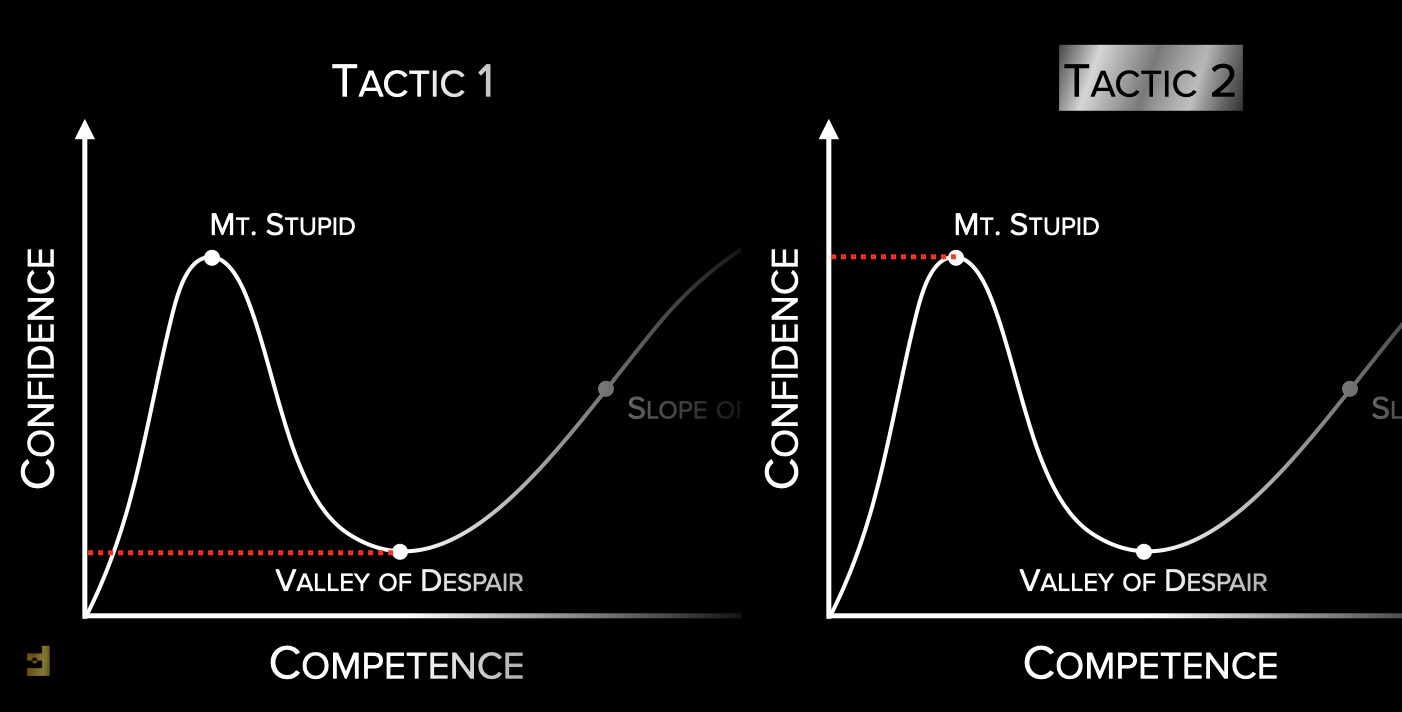
This is why it’s so important to be aware of this cycle. When you’re aware of this process and how you behave throughout the process, you’re more likely to catch yourself before jumping ship.
And when you do catch yourself, you have the opportunity to make an honest assessment.
Choose Your Own Ending
In the depths of the valley of despair, there is a fork in the road.
Imposter syndrome and the valley create the right conditions, and it’s triggered by a shiny object. This is your opportunity for assessment.
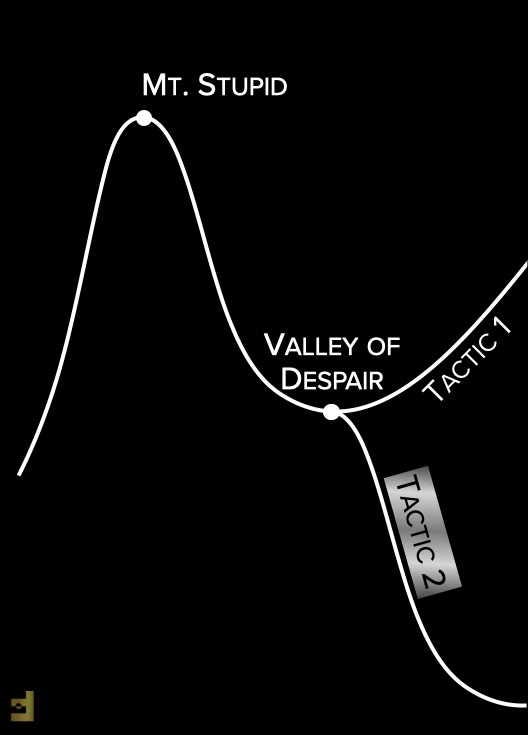
You now have two paths in front of you. Jump ship and focus on the new shiny object, or dismiss it and remain focused on your current plan, persisting through the uphill battle.
And this is not about “being a man and toughening up” to push through. It’s about actually assessing your options. Sometimes your current plan is inferior and it’s worth considering another option. But whichever way you make your decision, don’t make it blindly or based only on short term factors.
Imposter syndrome, the valley of despair, and shiny object syndrome are inextricably linked in a vicious cycle, one feeding into the next. The only way out is fighting the uphill battle to achievement. The question is just which opportunity is worth the uphill battle.
Ultimately, it’s up to you to make that call. I’ve written a few essays with the goal of pointing you in the right direction to make it as easy as possible. (Check out these essays if you’re interested: 3 Keys to Maximize Financial Autonomy; The Holy Trinity of Solo Online Business)

But “as easy as possible” does not mean “easy.” If a caveman could do it, everyone would be doing it. But it’s not, so they don’t. The goal is to find an opportunity that makes it easy to say no to the shiny objects, especially in the valley of despair.
There are a few things you can do to accomplish this, and we’ve already taken care of one of them.
1- Be aware of the cycle.
This is the most important one because, as we talked about before, if you are not aware of the cycle, you are likely to mistake the valley of despair for reasons to quit and doom yourself to repeating the cycle.
Part of being aware is having the ability to step back and realize when you are in the valley. In the depths of frustration it can be easy to lose sight of the process, even if you’ve been made aware of it in the past.
Take a breath and remember you’re halfway through the race. You can keep going, or you can give up and go back to the start line to keep repeating the worst parts of the race. This is why I’m so adamant about building a long-term business instead of chasing trends and hacks that will be obsolete in months.
2- Be consistent and persistent
Pretty much the only way up the slope of enlightenment or informed optimism is to just show up every day and move the needle forward. Eliminate as many detractors as possible and be strict about what you allow to interrupt your focus.
The simplest mechanism for consistent persistence is the one-day-off rule, which says that when you need a day off, take a day off. But don’t take 2 days off in a row. This keeps consistency high, while giving you time to recover, thereby reducing the risk of burnout.
This can require serious discipline, so it’s important to give yourself every advantage possible.
3- Seek obsession
Chris Williamson, host of the Modern Wisdom podcast, wrote a short essay about this. The essence is this: Discipline is a great tool for maintaining consistency. But an even better tool is motivation.
If you are externally motivated to do something, there is less resistance than if you have to discipline yourself to do the thing.
And even better than being motivated is being obsessed, which is an internal drive. When there is literally nothing you would rather be doing than this, you stay consistent and persistent just by default.
To really make this work like magic, you have to apply this in two places.
First, the end goal. What is the desired outcome that you are absolutely obsessed with, you cannot get it out of your head. If you feel any level of apathy toward the final goal, odds are good you’ll struggle to maintain consistency.
The same thing applies to the individual steps to achieve that end goal. You might really want a castle, but if you hate laying bricks, the process is not going to be enjoyable and you’re likely to quit before it’s finished.
If you love laying bricks, then you just enjoy the process and the castle is completed as a byproduct. Ideally, you find a project where you’re obsessed with the “castle”, and “laying the bricks.”
4- Seek like minded people
One of the most effective ways to maintain consistency is to surround yourself with people who have goals and ambitions similar to yours. The people who are in the same part of the journey as you become your allies. They can validate your struggles and remind you it’s part of the process, keeping you motivated.
The people who are ahead of you have a lot of valuable experience to share with you. They can help you avoid painful mistakes before you even encounter them, and provide clarity on new challenges.
Even the people who aren’t as far along in the process can be beneficial to you. These people give you opportunities to employ the Feynman Technique. By sharing your knowledge with the people who lack it, you uncover hidden gaps in your own knowledge and deepen your understanding of the subject.
The best way to do this is to join a community about your topic of obsession. Connect with people behind you and those who are further along. Ask questions when you get stuck and share your findings to help others keep moving forward as well. Form alliances with peers, collaborate, and share audiences where it makes sense. This is the best way to get from zero to one.
If you want to see it in action you can join the Future of Freedom VIP Community completely free. This community was built specifically for entrepreneurs and people looking to generate independent income online.
My goal is to help you develop the mindset, skillset, and toolset to succeed in digital business and cultivate financial autonomy.
And like I said before, “as easy as possible” doesn’t mean easy. But you know the saying: “Nothing that’s easy is worth doing, and nothing worth doing is easy.”
The VIP community is here to help you keep pushing through the uphill battle and join us in stage 5, success.
Consider this an open invitation. Join whenever it makes sense for you.
See you inside,
Tim
Thanks for reading. Subscribe for more.